

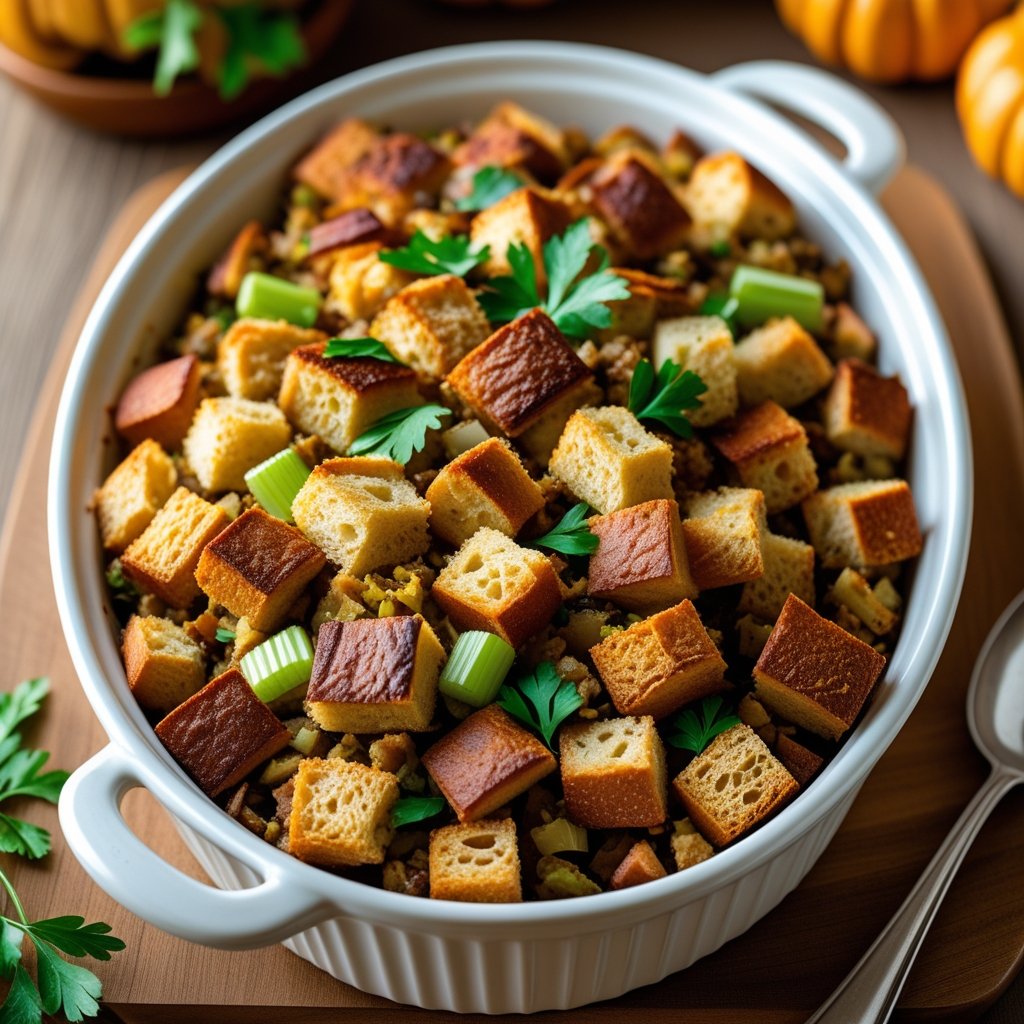
Thanksgiving stuffing is the side dish everyone reaches for first, and Grandma’s Thanksgiving Stuffing is the version that turns a holiday table into a memory. This is the classic recipe passed down through family dinners: cubes of day-old bread, a whole cup of butter, sweet onion and celery, and the warm trio of sage, thyme and rosemary, all moistened with broth and bound with eggs, then baked until the top turns golden and crisp. It takes just 1 hour and 5 minutes from start to finish, serves 8 people, and tastes like the Thanksgiving you grew up with.
Stuffing is the most-searched Thanksgiving side dish in America, and for good reason. It is the dish that ties the whole meal together. It soaks up gravy, sits happily next to roast turkey, and somehow tastes even better the next day. This guide walks you through the full recipe exactly as it appears on Recipes Walay, with every ingredient, every step, smart variations, make-ahead timing, storage advice, and answers to the questions people actually ask before they bake it.
If you are cooking Thanksgiving dinner this year, start here. This stuffing is simple, forgiving, and made from ingredients you probably already have in the kitchen.
Why You Will Love Grandma’s Thanksgiving Stuffing
There are stuffing recipes that try too hard, with long ingredient lists and fussy techniques. This is not one of them. Grandma’s Thanksgiving Stuffing uses 12 everyday ingredients and one baking dish, and it delivers the exact flavour people expect from Thanksgiving: buttery, herby, soft inside and crisp on top.
First, it is genuinely easy. The whole recipe is one skillet, one bowl and one baking dish. You melt butter, soften onion and celery, toss everything together, and bake. There is no stuffing a bird, no special equipment, and no step that needs perfect timing. If you can stir, you can make this stuffing.
Second, it feeds a crowd. One batch serves 8 people, which is exactly right for a family Thanksgiving table, and the recipe doubles cleanly if your guest list is bigger. Just use a larger baking dish and keep the same oven temperature and baking time, checking that the centre is hot all the way through.
Third, the flavour is balanced, not overpowering. The sage, thyme and rosemary are measured carefully: 1 1/2 teaspoons of dried sage, 1 teaspoon of dried thyme and 1 teaspoon of dried rosemary. That is enough to taste the herbs in every bite without any single herb taking over. The butter carries the flavour, the broth keeps the bread moist, and the eggs hold everything together so the stuffing slices and serves neatly instead of falling apart.
Finally, this is a recipe with a story. It has been passed down for years, served at family dinners where the smell of onion, celery and sage filled the house. Serve it once, and it becomes a holiday favourite forever. That is what Grandma’s Thanksgiving Stuffing is really about: not just a side dish, but the feeling of being home.
What Makes This Stuffing So Special
Every family has a stuffing, but this one earns its place because of three choices Grandma made and never changed.
The first is day-old bread. The recipe calls for 10 cups of cubed day-old bread, and that is not a suggestion to use up leftovers. Stale bread is the secret to stuffing that holds its shape. Fresh bread turns to mush the moment broth hits it, while day-old bread drinks up the butter and broth slowly and keeps a little chew. If your bread is still fresh, cut it into cubes and leave it out on a baking sheet for a few hours, or dry it in a low oven for 10 minutes before you start.
The second is butter, and plenty of it. One full cup of unsalted butter is melted in the skillet and poured over the bread. Butter is what makes the stuffing taste rich and gives the top its golden, crisp edges. Unsalted butter matters here because the recipe already adds 2 teaspoons of salt, and you want to control the seasoning yourself.
The third is the herb trio. Sage is the classic Thanksgiving herb, and it leads here. Thyme and rosemary back it up with earthy, piney notes that smell like the holidays. Dried herbs are what the recipe uses, and they work beautifully because they bloom in the hot butter before they ever meet the bread. If you have fresh herbs, the recipe’s own tips say they give a stronger taste, so use them when you can.
Put those three choices together and you get stuffing that is soft and savoury inside, crisp on top, and full of the flavours people associate with Thanksgiving itself. It is the kind of dish that needs no garnish and no apology.
Ingredients You Will Need
This recipe serves 8 people and uses 12 ingredients. Measure everything before you start so the cooking moves quickly once the butter is melted.
- 10 cups cubed day-old bread
- 1 cup unsalted butter
- 2 cups diced celery
- 2 cups chopped onion
- 2 teaspoons salt
- 1 teaspoon black pepper
- 1 1/2 teaspoons dried sage
- 1 teaspoon dried thyme
- 1 teaspoon dried rosemary
- 3 cups chicken or turkey broth
- 2 large eggs, beaten
- 1/2 cup chopped parsley
A few notes on the ingredients. The bread is the backbone of the dish, so use a sturdy loaf: white bread, sourdough or French bread all work well. Avoid very soft sandwich bread, which can turn soggy. The broth can be chicken or turkey broth, whichever you have; turkey broth is a lovely choice if you have it from cooking the bird, because it ties the stuffing to the rest of the meal. The eggs must be beaten before they go in, so they mix evenly through the bread instead of cooking in streaks. And the parsley goes in near the end, so it keeps its fresh, bright flavour.
Equipment You Will Need
You do not need any special equipment for this stuffing. Everything on this list is standard kitchen gear:
- Large mixing bowl
- Cutting board
- Sharp knife
- Wooden spoon
- Measuring cups
- Measuring spoons
- Large skillet
- Baking dish
- Whisk
- Aluminium foil
The large mixing bowl matters most. Ten cups of bread cubes take up a lot of room, and you need space to toss everything without bread spilling over the sides. If your biggest bowl feels tight, mix in two batches or use a large roasting pan as the mixing bowl. The whisk is for beating the eggs; a fork works just as well if you do not have one.
How to Make Grandma’s Thanksgiving Stuffing
Preheat your oven to 350 degrees Fahrenheit before you do anything else, so it is fully hot when the stuffing goes in. Grease your baking dish with butter. Then follow these 12 steps.
- Preheat the oven and grease the dish. Set the oven to 350 degrees Fahrenheit. Grease a baking dish with butter so the stuffing releases cleanly when you serve it.
- Melt the butter. Put 1 cup of unsalted butter in a large skillet over medium heat and let it melt completely. Do not let it brown; you want it just melted and hot.
- Cook the onion and celery. Add 2 cups of chopped onion and 2 cups of diced celery to the melted butter. Cook until soft, stirring now and then. This usually takes about 5 minutes. Soft vegetables blend into the stuffing; crunchy ones stand out in the wrong way.
- Stir in the herbs. Add 1 1/2 teaspoons of dried sage, 1 teaspoon of dried thyme and 1 teaspoon of dried rosemary to the skillet. Stir for about a minute so the herbs warm in the butter and release their fragrance.
- Put the bread in a large bowl. Place 10 cups of cubed day-old bread in a large mixing bowl. Make sure the cubes are roughly the same size so they moisten evenly.
- Pour the cooked mixture over the bread. Pour the hot butter, onion, celery and herb mixture over the bread cubes. The heat helps the bread start absorbing the butter right away.
- Add the seasoning and parsley. Add 2 teaspoons of salt, 1 teaspoon of black pepper and 1/2 cup of chopped parsley. Toss gently so the seasoning spreads through the bread.
- Pour in the broth slowly. Pour 3 cups of chicken or turkey broth over the bread a little at a time, mixing as you go, until the bread is moistened all the way through. Do not pour it all in at once. The goal is moist bread, not soup. Stop if the bread looks wet enough before you have used all the broth; the exact amount depends on how dry your bread is.
- Stir in the beaten eggs. Pour in the 2 beaten eggs and stir gently until they are mixed through. The eggs bind the stuffing so it holds together when baked and served. Mix gently; rough stirring breaks the bread cubes into mush.
- Transfer to the baking dish. Spoon the mixture into the greased baking dish and spread it into an even layer. Press it down lightly, but do not pack it tight. A loosely packed stuffing bakes up lighter.
- Cover and bake for 30 minutes. Cover the dish tightly with aluminium foil and bake at 350 degrees Fahrenheit for 30 minutes. The foil traps steam, which cooks the stuffing through and keeps the inside soft.
- Uncover, bake 15 minutes more, and serve. Remove the foil and bake for another 15 minutes, until the top is golden and crisp. That uncovered finish is what gives the stuffing its wonderful contrast: soft inside, crunchy on top. Serve hot, with turkey or gravy.
Total time is 1 hour and 5 minutes: 20 minutes of preparation and 45 minutes in the oven. One serving has about 280 calories. The recipe card on the single gives no further nutrition information, so this guide states only the 280 calories the recipe itself provides.
Tips for Perfect Stuffing Every Time
These 7 tips come straight from the recipe, and each one fixes a mistake that is easy to make.
Use stale bread for the best texture. Day-old bread is not a compromise; it is the ingredient that makes stuffing work. Fresh bread soaks up broth too fast and collapses. If you only have fresh bread, cube it and dry it out first.
Add sausage for extra flavour. If you want a heartier stuffing, brown some sausage, drain it, and stir it in with the bread. It turns this side dish into something closer to a main course, and it is a favourite variation for families who like a richer stuffing.
Use fresh herbs for a stronger taste. Dried sage, thyme and rosemary are what the recipe calls for, and they are excellent. But if you have fresh herbs in the garden or the shops, they give the stuffing a brighter, stronger flavour. Use roughly three times the amount of fresh herbs as dried.
Do not over-wet the bread cubes. This is the single most common stuffing mistake. Pour the broth slowly and stop when the bread is moist but still holds its shape. You can always add a splash more broth later, but you cannot take sogginess out.
Bake uncovered for a crispy top. The foil-covered first bake cooks the stuffing through. The uncovered second bake is what makes the top golden and crisp. Do not skip it, and do not be tempted to leave the foil on for the whole bake.
Make ahead and refrigerate overnight. This stuffing is a gift to the Thanksgiving cook. Assemble it the day before, cover it and refrigerate overnight, then bake it on the day. That frees up your oven and your morning for the turkey.
Mix gently to avoid mushy stuffing. Every time you stir, do it with a light hand. The bread cubes should stay recognisable. Gentle folding, not vigorous stirring, is the way.
Easy Variations to Try
Once you have made the classic version, these variations keep the same base and change the character of the dish.
Sausage and apple stuffing. Add browned sausage and a cup of diced apple when you mix the bread. The apple adds a sweet note that plays beautifully against the sage, and the sausage makes it hearty.
Mushroom stuffing. Cook sliced mushrooms with the onion and celery in Step 3. Mushrooms add an earthy depth and a little extra moisture, so hold back a splash of broth.
Cornbread stuffing. Swap half the white bread cubes for cubed cornbread. The cornbread brings a gentle sweetness and a golden colour that looks wonderful on the table.
Nutty stuffing. Stir in a cup of toasted pecans or walnuts with the bread. The nuts stay crunchy through baking and add richness.
Vegetarian stuffing. Use vegetable broth instead of chicken or turkey broth and skip the sausage variation. The recipe is already nearly vegetarian; the broth swap is the only change needed.
Spicy stuffing. Add a pinch of red pepper flakes or a diced jalapeño with the onion and celery. It will not make the stuffing hot, just warm and interesting.
Each variation keeps the same method, the same oven temperature and the same baking time, so you can adapt without relearning the recipe.
Make-Ahead and Timing Tips
Thanksgiving cooking is a scheduling puzzle, and stuffing is one of the easiest pieces to move earlier in the day.
The recipe itself says to make it ahead and refrigerate overnight, and that is the best approach. Assemble the stuffing fully the day before, press it into the baking dish, cover tightly with foil and refrigerate. On Thanksgiving Day, take it out of the fridge while the oven preheats, then bake as usual. If it goes into the oven cold, add about 10 minutes to the covered baking time and check that the centre is hot before you uncover it.
If you are short on time, you can also prep the parts separately. Cube the bread the night before and leave it out to dry. Chop the onion, celery and parsley and store them in containers in the fridge. In the morning, the cooking itself takes only 20 minutes before the dish goes in the oven.
On the day, bake the stuffing while the turkey rests. A roast turkey needs 20 to 30 minutes of resting anyway, and the stuffing’s 45 minutes in the oven fits neatly into that window if you plan it: put the stuffing in as the turkey comes out, and both will be ready together. If oven space is tight, the stuffing bakes happily at 325 to 375 degrees alongside other dishes; just watch the top and adjust the uncovered time.
How to Store Leftovers
Leftover stuffing is one of the best parts of Thanksgiving, and it deserves proper storage.
Let the stuffing cool to room temperature before you pack it away, then store it in an airtight container. The single recipe gives no fridge or freezer durations, so this guide states that plainly and gives no invented numbers: refrigerate the leftovers promptly and use them within a few days, and freeze only if you are confident about your own freezer storage routine. Reheat gently in the oven with a splash of broth to bring back the moisture, or warm single portions in the microwave.
The most important rule is the one the recipe already gives: do not over-wet the bread in the first place. Stuffing that starts out soggy will never recover in storage, while stuffing made with the right amount of broth reheats beautifully.
What to Serve With Grandma’s Thanksgiving Stuffing
Stuffing never sits alone on the plate. The recipe suggests 10 pairings, and together they make a complete Thanksgiving meal.
Roast Turkey. The classic choice, juicy and flavourful. The turkey is the centrepiece and the stuffing is its best friend. Try our Easy Martha Stewart Roast Turkey for Thanksgiving for a bird that matches this stuffing perfectly.
Mashed Potatoes. Creamy and buttery, great with gravy. Mashed potatoes and stuffing side by side is the comfort-food combination every Thanksgiving table needs.
Green Bean Casserole. Crispy topping, creamy inside. It adds a green vegetable and a different texture to the plate. Our Easy Paula Deen Green Bean Casserole for Thanksgiving is a crowd favourite.
Cranberry Sauce. Sweet-tart flavour balances the rich, buttery stuffing. A spoonful of cranberry sauce next to the stuffing cuts through the richness. See our Easy Cranberry Relish for the Holidays.
Roasted Brussels Sprouts. Adds crunch and freshness. Their slight bitterness is a good contrast to the soft, savoury stuffing.
Glazed Carrots. Sweet, tender and colourful. They bring colour to the plate and a gentle sweetness that children love.
Pumpkin Soup. Warm and smooth, a seasonal delight. A small bowl of pumpkin soup before the main meal sets the autumn mood.
Gravy. Poured over stuffing and turkey. Good gravy is not optional; it is what turns good stuffing into great stuffing.
Sweet Potato Casserole. Rich and topped with marshmallows. It is the sweet counterpart to the savoury stuffing. Our Easy Sweet Potato Casserole for Thanksgiving covers it in full.
Dinner Rolls. Soft bread to complete the plate. Rolls are there for mopping up gravy and for anyone who wants a little more bread with their bread-based side.
For the main course, Easy Thanksgiving Prime Rib for the Holidays and Easy Turkey Breast with Cranberry Orange Sauce for Thanksgiving are both excellent with this stuffing. If you want a different stuffing idea for a second table, try our Easy Stuffing Balls for Thanksgiving. And if you love this dish, you will find more ideas in our Easy Thanksgiving Stuffing Recipes roundup.
Frequently Asked Questions
Can I make Grandma’s Thanksgiving stuffing ahead of time?
Yes. The recipe itself recommends making it ahead and refrigerating it overnight. Assemble the stuffing completely, cover the baking dish tightly and refrigerate. On the day, bake as directed, adding about 10 minutes to the covered bake if it goes into the oven straight from the fridge. This is the single best way to take pressure off Thanksgiving morning.
What kind of bread is best for Thanksgiving stuffing?
Day-old, sturdy bread is best. White bread, sourdough or French bread all work well because they hold their shape when moistened. Avoid very soft sandwich bread, which can turn mushy. The recipe calls for 10 cups of cubed day-old bread, and if your bread is fresh, cut it into cubes and leave it out for a few hours or dry it in a low oven first.
Should stuffing be cooked inside the turkey?
No, this recipe is baked in a baking dish, not inside the bird, and that is the safer and more reliable method. Stuffing cooked inside a turkey must reach a safe temperature all the way through, which is hard to guarantee and often overcooks the turkey. Baking it separately gives you a crisp top, even cooking and full control.
Why is my stuffing soggy?
Soggy stuffing almost always means too much liquid. The recipe warns not to over-wet the bread cubes. Pour the broth in slowly and stop when the bread is moist but still holds its shape. Using fresh bread instead of day-old bread is the other common cause, because fresh bread absorbs liquid too fast and collapses.
Can I add sausage to this stuffing?
Yes. The recipe’s own tips suggest adding sausage for extra flavour. Brown the sausage first, drain off the fat, and stir it in with the bread cubes. It makes the stuffing heartier and richer, and it is a popular variation for families who want something more substantial.
How long do I bake the stuffing?
Bake covered with foil at 350 degrees Fahrenheit for 30 minutes, then uncovered for another 15 minutes, for 45 minutes of cooking time in total. The covered bake cooks it through and keeps it moist; the uncovered bake makes the top golden and crisp. With 20 minutes of preparation, the total time is 1 hour and 5 minutes.
Why This Stuffing Belongs on Your Thanksgiving Table
Thanksgiving is the one meal of the year where tradition matters more than novelty, and stuffing is the dish that carries the most tradition. It is the side that people ask about by name, the one they hope is on the table, and the one they talk about on the way home.
This recipe earns that place because it is exactly what stuffing should be: simple ingredients, honest flavours, and a method anyone can follow. It does not need a long shopping list or a special technique. It needs day-old bread, butter, onion, celery, herbs, broth and eggs, and 65 minutes of your time.
It also fits the way Thanksgiving actually works. You can make it the night before. It bakes while the turkey rests. It feeds 8 people from a single dish. And it goes with everything else on the table, from roast turkey to cranberry sauce. If you are looking for more holiday appetiser ideas, our Easy Christmas Cranberry Meatballs for the Holidays is a festive next bake.
Final Thoughts
Grandma’s Thanksgiving Stuffing is more than a recipe. It is a dish filled with love, built from herbs, bread and butter, and served at the table where family gathers. The flavours blend beautifully with turkey and holiday dishes, and every bite takes you back to cherished family gatherings.
Try it once, and it will be your yearly tradition too. Make it the night before, bake it while the turkey rests, serve it hot with gravy, and watch it disappear before the mashed potatoes do. That is the test of a great stuffing, and this one passes it every year.
Happy Thanksgiving, and happy cooking.