

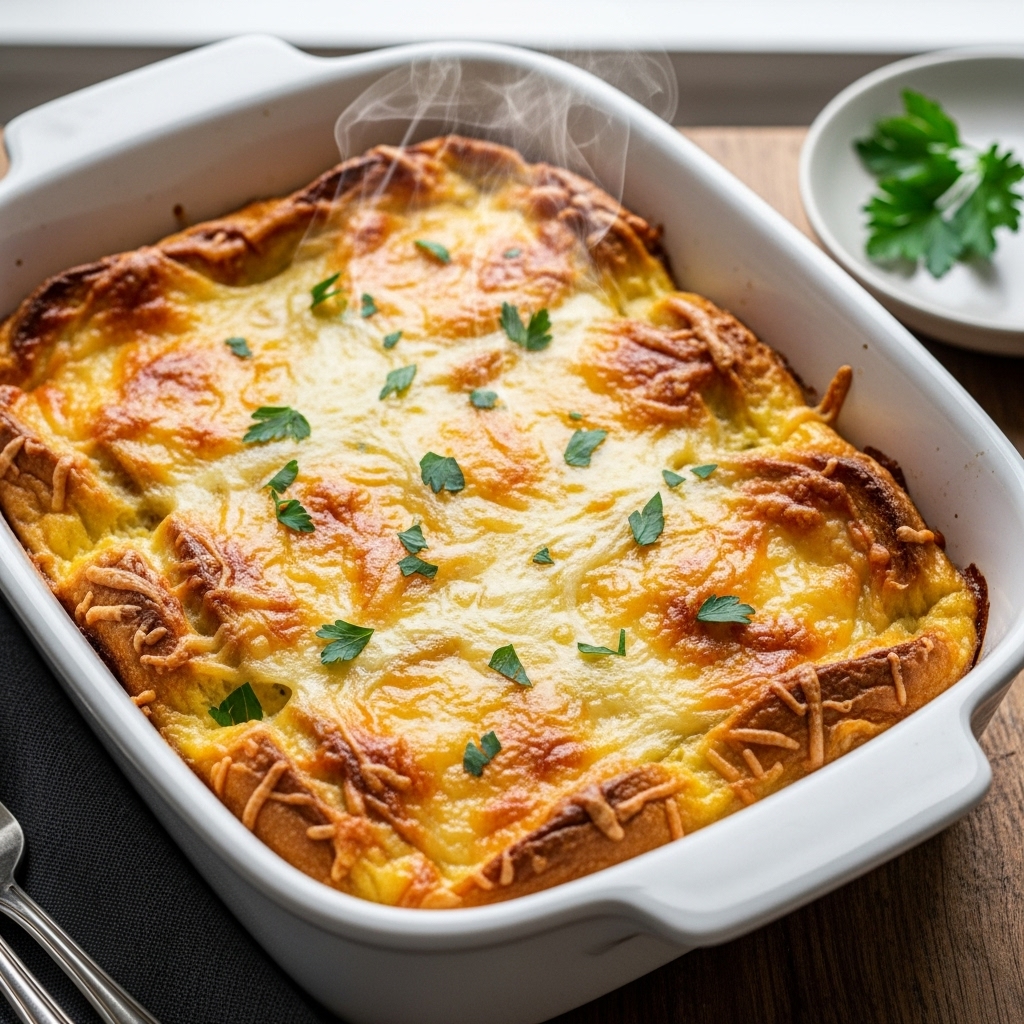
There are Christmas mornings that start with a rush, and then there is the kind of Christmas morning that starts with a breakfast strata already waiting in the fridge. Ina Garten Breakfast Strata is a baked dish of crusty bread, eggs, milk, cream and two cheeses, assembled the night before and baked until golden and set. It is warm, creamy and deeply comforting, it feeds a whole family from a single dish, and it is exactly the kind of breakfast that makes Christmas morning feel unhurried.
A breakfast strata is one of those recipes that sounds fancy and turns out to be wonderfully simple. Eggs, milk and cream are whisked into a custard, poured over cubes of crusty bread and shredded cheese, and left overnight so the bread soaks up the custard without turning soggy. The next morning it goes into the oven, and what comes out is golden on top, soft and creamy inside, and ready to slice. The recipe takes 20 minutes of prep and 50 minutes in the oven, it serves 8 people, and the overnight rest means the work is done before Christmas Day even begins. This guide walks you through the full recipe exactly as it appears on Recipes Walay, with every ingredient, every step, expert tips, variations, serving ideas and answers to the questions people actually ask before they make it.
The full recipe is on Recipes Walay at https://recipeswalay.com/ina-garten-breakfast-strata-recipe/
Why You Will Love Ina Garten Breakfast Strata
Some recipes earn their place through speed, and some through flavour. This one manages both, which is why it is such a useful dish to have in your collection. It takes just 20 minutes of hands-on prep, the oven does the rest in 50 minutes, and it feeds 8 people generously, so it is easy to fit into a busy Christmas morning or a relaxed family brunch.
First, the texture is the whole point, and this recipe is built to get it right. Crusty bread soaks up the egg custard overnight, but because the bread is day-old and sturdy, it holds its shape instead of collapsing into mush. The result is soft and creamy inside, with a golden, slightly crisp top, and a richness that comes from the Gruyère and Parmesan melting through every layer. It is the kind of texture that feels indulgent without being heavy.
Second, the method is almost embarrassingly easy. There is no fussy technique and no last-minute juggling. You layer bread, onion and cheese in a dish, whisk the custard, pour it over, cover it and put it in the fridge. The next morning you slide it into the oven and take it out when it is golden and set. That is the whole recipe. For a Christmas morning, where the house is already busy and the cook is already stretched, a breakfast that asks for so little is worth its weight in gold.
Third, it is a genuine make-ahead dish. The overnight rest is not an optional extra, it is the heart of the recipe, and it means the dish is fully prepared a day before you need it. On Christmas morning itself you only have to bake it, which frees up the morning for presents, family and everything else. And because it serves 8 from a single 9 by 13 dish, it scales easily for a house full of guests.
What Is a Breakfast Strata?
A breakfast strata is a baked egg and bread casserole, built in layers and left to rest overnight so the bread absorbs the custard. The name comes from the Latin word for layers, and that is exactly how it is made: cubes of crusty bread form the base, sautéed onion and shredded cheese are layered through it, and a whisked mixture of eggs, milk, cream and seasoning is poured over the top. Left overnight in the fridge, the bread drinks in the custard, and the next morning the whole dish bakes into something golden, puffed and set.
The dish works because of a simple balance. Eggs create structure and richness, while the bread absorbs the custard without turning soggy. Cheese adds depth and comfort, and the overnight resting improves the flavour greatly, because it gives every ingredient time to blend. Baking finishes everything evenly, and the results stay consistent every single time. It is a dish that is forgiving by nature: the overnight soak does the hard work, and the bake is simply the finish.
Ina Garten’s version follows this classic pattern with her usual calm confidence. There are no complicated steps and no hard-to-find ingredients, just good ingredients treated properly: day-old crusty bread, fresh-shredded Gruyère, real cream, and a gentle hand with the seasoning. A pinch of nutmeg gives the custard a warm, subtle depth that people notice without being able to name it. The recipe is American in cuisine, a breakfast dish by definition, and it has become a favourite for holidays precisely because it feels elegant while asking so little of the cook.
It is worth saying plainly what a breakfast strata is not. It is not a quiche, because there is no pastry crust and the bread is the structure. It is not French toast, because it is baked as a whole dish and sliced like a casserole. And it is not a dish you can rush: the time in the fridge is doing real work, softening the bread and letting the flavours blend. Give it that time, and the dish rewards you.
Ingredients You Need for Ina Garten Breakfast Strata (with Quantities)
One of the best things about this recipe is how short the shopping list is. Eleven ingredients, all easy to find, and every one of them earns its place. Here is the full list, with the exact quantities from the recipe on Recipes Walay:
- 6 cups crusty bread, cubed
- 8 large eggs
- 2 cups whole milk
- 1 cup heavy cream
- 2 cups shredded Gruyère cheese
- 1/2 cup grated Parmesan cheese
- 1 small onion, diced
- 2 tablespoons unsalted butter
- 1 teaspoon salt
- 1/2 teaspoon black pepper
- 1/4 teaspoon nutmeg
A few notes on the ingredients will help you get the best result. First, use day-old crusty bread, and only day-old bread. The recipe is explicit about this, and it matters: fresh bread is too soft, and it will collapse into mush during the overnight soak. Day-old bread is firm enough to hold its shape while it absorbs the custard, and that is what gives the finished strata its texture. Cut it into even cubes, roughly an inch across, so they soak evenly.
Second, shred the cheese fresh. The recipe calls for 2 cups of shredded Gruyère and half a cup of grated Parmesan, and freshly shredded cheese melts far more smoothly than pre-shredded cheese, which is coated in a substance that stops it clumping in the bag and can make melted cheese slightly grainy. Gruyère is the right choice here because it melts beautifully and has a nutty, slightly sweet flavour that suits the eggs and cream. Grate it yourself, and the difference shows.
Third, use whole milk and real heavy cream, not low-fat substitutes. The fat in the milk and cream is what gives the custard its richness and helps it set into a soft, creamy texture. Skimmed milk will make a thinner, less satisfying custard, and the dish will not have the same luxurious feel. Use unsalted butter for sautéing the onion, so that you control the salt: the recipe already includes a teaspoon of salt in the custard, and unsalted butter keeps the seasoning exactly where the recipe intends it.
Finally, do not skip the nutmeg. A quarter of a teaspoon seems small, but it is the quiet seasoning that makes the custard taste complete. Nutmeg has a warm, slightly sweet depth that works beautifully with eggs, milk and cheese, and it is the difference between a strata that tastes good and one that tastes finished. Freshly grated nutmeg is best, but ground nutmeg from a jar works well too.
Equipment You Need
You do not need any special equipment for this recipe, and that is part of its charm. Everything on this list is standard kitchen equipment:
- Large mixing bowl
- Whisk
- 9×13 baking dish
- Measuring cups
- Measuring spoons
- Cutting board
- Sharp knife
- Aluminum foil
The 9 by 13 baking dish matters more than it might seem, because it is the size the recipe is written for: 6 cups of bread, 8 eggs and 3 cups of liquid fit it exactly, and the depth is right for the custard to soak through without the dish overflowing. A dish that is too small will overflow, and a dish that is too large will make a thin strata that dries out. The whisk is essential for the custard, because the eggs, milk and cream have to be fully combined before they are poured over the bread. The aluminum foil is there to cover the dish while the strata rests overnight in the fridge. And the sharp knife and cutting board are for cubing the bread and dicing the onion.
How to Make Ina Garten Breakfast Strata Step by Step
The recipe card gives a total time of 1 hour and 10 minutes: 20 minutes of prep and 50 minutes of cooking. That total does not include the overnight rest, which is a separate step the night before. The steps below follow the recipe on Recipes Walay exactly, broken into twelve clear stages so you can follow them one at a time without losing your place.
1. Grease the Baking Dish Lightly
Start by greasing a 9 by 13 baking dish lightly. Use a little butter or a light coating of cooking spray, and make sure you reach the corners and the sides as well as the base. This step is small, but it matters: it stops the bread and cheese from sticking to the dish, and it makes serving much easier the next morning, when the strata is hot and you want clean slices.
2. Spread the Bread Cubes Evenly Inside
Spread 6 cups of cubed crusty bread evenly inside the greased baking dish. The cubes should form a single, even layer, with no big gaps and no tall piles. Even layering matters, because the custard has to reach every piece of bread, and a lopsided layer means some cubes will soak while others stay dry. Take a moment to spread them out properly, and make sure the bread reaches into the corners of the dish.
3. Melt the Butter and Sauté the Onion Until Soft
Melt 2 tablespoons of unsalted butter in a pan over a medium heat, and sauté 1 small diced onion in it until soft. This takes just a few minutes: the onion should turn translucent and soft, with no colour on it, and it should smell sweet rather than sharp. Sautéing the onion first is important, because raw onion would stay crunchy and harsh in the finished strata, while a softened onion melts into the custard and adds a gentle sweetness.
4. Sprinkle the Onion Over the Bread
Sprinkle the sautéed onion evenly over the bread cubes in the baking dish. Try to distribute it across the whole dish rather than letting it land in one spot, so every slice of the finished strata gets a little onion. Use a spoon to scatter it, and make sure it falls between the bread cubes as well as on top of them, so the flavour runs all the way through.
5. Add the Cheeses Evenly on Top
Add 2 cups of shredded Gruyère cheese and half a cup of grated Parmesan cheese evenly on top of the bread and onion. Again, spread them out so every part of the dish gets its share. The Gruyère is the main cheese here, giving the strata its nutty richness, while the Parmesan adds a salty, savoury sharpness. Getting both cheeses into every layer is what makes the finished dish taste consistent from the first slice to the last.
6. Whisk the Eggs, Milk and Cream Well
In a large mixing bowl, whisk 8 large eggs, 2 cups of whole milk and 1 cup of heavy cream together until they are fully combined. Whisk thoroughly, until the mixture is smooth and uniform, with no streaks of egg white or yolk visible. This is the custard that holds the whole dish together, and a well-whisked custard sets evenly, while a poorly mixed one can leave patches of plain egg or plain milk in the finished strata.
7. Season the Custard with Salt, Pepper and Nutmeg
Season the whisked custard with 1 teaspoon of salt, half a teaspoon of black pepper and a quarter teaspoon of nutmeg, and whisk again to mix the seasonings through. The nutmeg is the quiet star here: a quarter of a teaspoon is enough to give the custard a warm depth without announcing itself. Taste the custard if you like, and check that the seasoning is even, because this is your last chance to adjust it before it goes over the bread.
8. Pour the Custard Over the Bread
Pour the seasoned custard evenly over the bread, onion and cheese in the baking dish. Pour slowly and move the bowl around the dish so the custard reaches every corner. The bread will start to absorb the liquid straight away, and you should see the level of the custard settle among the cubes. Make sure no dry patches of bread are left sitting above the custard line.
9. Press the Bread Down Gently So It Soaks
Press the bread cubes down gently into the custard, so that every piece is in contact with the liquid. Use the back of a spoon or your hands, and press lightly rather than crushing the bread: the aim is to help the cubes absorb the custard, not to flatten them. This step is what stops the top layer from staying dry overnight, and it is the difference between a strata that is creamy all the way through and one that has a dry crust on top.
10. Cover and Refrigerate Overnight
Cover the baking dish tightly with aluminum foil and put it in the refrigerator to rest overnight. This is the most important step in the whole recipe, and it is not optional. Overnight in the fridge, the bread absorbs the custard slowly and evenly, the cheese begins to blend with the eggs, and the flavours deepen. A short soak will give you a strata, but it will not give you this strata: the overnight rest is what makes the texture soft and creamy instead of patchy and dry.
11. Bake Uncovered Until Golden and Set
The next morning, take the dish out of the fridge and bake it uncovered until it is golden on top and set in the centre. It is worth saying plainly that the recipe on Recipes Walay does not state a baking temperature or an exact baking time for this step: the recipe card gives a cook time of 50 minutes, and the method says to bake until golden and set. Use those doneness cues as your guide. The top should be golden and lightly puffed, and the centre should feel firm when you press it gently, with no liquid custard wobbling underneath. If the top is browning too fast, cover it loosely with foil for the last part of the bake.
12. Let It Cool Slightly Before Slicing and Serving
Take the strata out of the oven and let it cool slightly before slicing. A brief rest lets the custard finish setting, so the slices hold their shape instead of falling apart on the plate. Cut it into squares in the dish, and serve it warm, straight from the baking dish, while it is still soft and creamy inside.
Expert Tips for Perfect Breakfast Strata
The recipe itself is simple, but a few habits make the difference between a good strata and a great strata. These tips come directly from the recipe on Recipes Walay, and they are worth reading before you start cooking, not after.
Use day-old bread only. This is the single most important tip in the recipe, and it is repeated in the method and the tips section for a reason. Fresh bread is too soft, and it will collapse into mush during the overnight soak. Day-old crusty bread is firm enough to hold its shape while it absorbs the custard, and that is what gives the finished strata its texture. If your bread is still fresh, cut it into cubes and leave them out on a tray for a few hours to dry out before you start.
Shred the cheese fresh for flavour. Pre-shredded cheese is coated in a substance that stops it clumping in the bag, and that coating can make melted cheese slightly grainy. Grating your own Gruyère takes only a minute, and it melts far more smoothly, which shows in the finished strata. Freshly grated Parmesan has the same advantage, and its flavour is noticeably sharper than the pre-grated kind.
Rest overnight for the best texture. The overnight rest is what makes this dish work. The bread needs time to absorb the custard slowly and evenly, and a short soak will leave you with dry patches on top and wet patches underneath. Assemble the strata the night before, put it in the fridge, and forget about it until morning. That is the whole point of the recipe.
Bake until the centre feels firm. The test for doneness is touch, not time. Press the centre of the strata gently: it should feel firm and spring back slightly, with no liquid custard moving underneath. The top should be golden and lightly puffed. If the centre still wobbles, give it a few more minutes in the oven, and if the top is browning too fast, cover it loosely with foil.
Let it cool slightly before slicing. A brief rest after the strata comes out of the oven lets the custard finish setting, so the slices hold their shape when you cut them. Cutting into it straight from the oven will give you a delicious mess rather than clean squares, so give it five or ten minutes on the counter first.
Variations to Try
Once you have made the classic version, this recipe is easy to adapt, and the variations below all stay true to the ingredients and method of the original. They are simple swaps that fit the same overnight soak and the same bake.
Swap the cheese. Gruyère is the classic choice, but you can use Swiss cheese for a milder flavour, sharp cheddar for a tangier bite, or fontina for an even creamier melt. Whatever you choose, make sure it is a good melting cheese, and grate it fresh. A cheese that does not melt smoothly will make the strata grainy, so avoid very hard or very crumbly cheeses.
Swap the bread. Crusty white bread is the base here, but brioche, challah or sourdough all work well, as long as they are day-old and cut into even cubes. Brioche gives a richer, slightly sweeter strata, challah gives a soft, eggy texture, and sourdough adds a gentle tang. Whatever bread you use, it must be stale enough to hold its shape overnight.
Add cooked sausage or bacon. For a heartier version, brown some sausage or cook some bacon, crumble it, and layer it in with the onion and cheese. This is the classic American brunch variation, and it turns the strata into a full meal in one dish. Make sure the meat is fully cooked and drained before it goes in, so it does not add grease to the custard.
Add sautéed mushrooms or spinach. For a vegetable version, sauté sliced mushrooms or a handful of spinach in the same butter as the onion, and layer them in with the bread. Mushrooms add an earthy depth, and spinach adds colour and a gentle bitterness that balances the richness of the cheese. Squeeze any excess water out of the spinach before it goes in, so the custard does not turn watery.
Make it in individual ramekins. For a fancier presentation, divide the same mixture between buttered ramekins instead of a single large dish. The overnight rest works the same way, and the bake will be quicker, so start checking after about 30 minutes. Individual stratas look lovely on a Christmas breakfast table, and they make serving effortless.
What to Serve with Breakfast Strata
A breakfast strata is the centrepiece of a Christmas morning table, and it needs very little alongside it. It is rich, warm and filling, so the best companions are simple things that balance it rather than compete with it.
For a classic Christmas breakfast, serve it with fresh fruit on the side. A bowl of berries, sliced oranges or a simple fruit salad adds brightness and freshness, and the cold fruit is a lovely contrast to the warm, creamy strata. Fresh fruit also gives the table a little colour, which matters on a Christmas morning when everything else on the plate is golden and brown.
For a heartier table, add bacon or sausage links alongside it. The salty, crisp meat is a natural partner for eggs and cheese, and it turns the strata from a single dish into a full breakfast spread. Cook the bacon or sausage while the strata bakes, and everything arrives at the table hot at the same time.
For drinks, coffee and orange juice are the obvious choices, and a pot of tea works just as well for a slower morning. The strata is rich, so a bright drink helps to cut through it, and a proper pot of coffee is part of the Christmas morning ritual for most families anyway.
Good companions from Recipes Walay for the wider holiday table include Joanna Gaines’ cornbread at https://recipeswalay.com/easy-joanna-gaines-cornbread-for-thanksgiving/ for a warm bread alongside the strata, Paula Deen’s garlic cheese grits at https://recipeswalay.com/easy-paula-deen-garlic-cheese-grits-for-thanksgiving/ for another rich, cheesy side, and Martha Stewart’s cranberry relish at https://recipeswalay.com/easy-martha-stewart-cranberry-relish-for-thanksgiving/ for a bright, tart contrast. Baked beans at https://recipeswalay.com/easy-baked-beans-for-the-holidays/ work well for a bigger brunch spread, white chicken chili at https://recipeswalay.com/easy-white-chicken-chili-for-winter-nights/ is a good later-in-the-day option, and corn pudding at https://recipeswalay.com/easy-corn-pudding-for-thanksgiving/ adds a sweet, creamy note. Sweet potato pie at https://recipeswalay.com/easy-sweet-potato-pie-for-thanksgiving/ finishes the holiday meal, Ina Garten’s baked ziti at https://recipeswalay.com/easy-ina-garten-baked-ziti-for-winter-nights/ is a reliable winter main for the evening, and Joanna Gaines’ creamy mac and cheese at https://recipeswalay.com/easy-joanna-gaines-creamy-mac-and-cheese-for-the-holidays/ is always welcome at a family table.
Make-Ahead and Storage
One of the practical strengths of this dish is that it is a make-ahead recipe by design. The overnight rest is not an optional extra, it is the recipe, and it means the dish is fully assembled a day before you need it. That is the whole point of a breakfast strata for Christmas morning: you do the work on Christmas Eve, and on Christmas Day you only have to bake it.
Assemble the strata the night before, cover it tightly with aluminum foil, and keep it in the refrigerator overnight. The next morning, take it out while the oven heats and bake it as directed. If you need to assemble it even earlier, the strata can sit in the fridge for up to a full day, but overnight is the timing the recipe is written for, and it gives the best result.
It is worth saying plainly that the recipe on Recipes Walay does not give leftover storage times for this dish. The recipe card covers the assembly, the overnight rest, the bake and the serving, and it does not say how long leftovers keep or whether they freeze well. As general food-safety practice, cooked egg dishes should be refrigerated promptly in a covered container and eaten within a few days, and reheated gently until hot all the way through, but those are general guidelines, not instructions from the recipe itself. If you are cooking for a crowd, it is better to make the right quantity and enjoy it fresh than to rely on leftovers.
For a Christmas morning, the best plan is simple: assemble on Christmas Eve, bake on Christmas morning, and serve it warm from the dish while everyone is still in their pyjamas. That takes the pressure off the morning itself and still gives you a breakfast that tastes like you spent hours on it.
Nutrition and Calories
The recipe gives a clear headline number and is honest about what this dish is: rich, comforting breakfast food, best enjoyed as part of a balanced plate rather than on its own. Each serving contains 420 calories, and the recipe serves 8 people.
It is worth saying plainly that the recipe on Recipes Walay does not give a fuller nutrition breakdown for this dish. There is no fat, protein, carbohydrate or sodium figure on the recipe card, only the 420 calories per serving, so this guide does not invent one. What the ingredients tell you is straightforward: 8 eggs, 2 cups of whole milk and a cup of heavy cream across 8 servings, with 2 cups of Gruyère and half a cup of Parmesan. The eggs provide the protein, the dairy provides the richness, and the bread provides the carbohydrates. It is a generous, satisfying breakfast, and it sits best on a plate with lighter sides, such as fresh fruit, to balance the richness.
If you want a lighter version, you can use low-fat milk instead of whole milk, but the recipe as written uses whole milk and heavy cream, and the cream is part of what gives the strata its soft, luxurious texture. For a Christmas morning, the classic version is the right choice, and the rest of the plate can carry the lighter dishes.
Occasions to Serve Breakfast Strata
This is a dish that fits more occasions than most breakfasts, and the recipe on Recipes Walay shows its range. For Christmas morning, it is a natural fit: it is elegant enough for the occasion, it feeds 8 from a single dish, and the overnight assembly means the cook is free on the morning itself. It is one of the few Christmas breakfasts that actually gets easier when you are cooking for a crowd, because the assembly and the bake scale without any extra effort.
For a holiday brunch, it is a reliable crowd-pleaser. The golden top and creamy centre look beautiful in the baking dish, it slices neatly, and it is the kind of dish that gets people talking. Serve it family-style, in the dish it baked in, and let people help themselves. It works just as well for a New Year’s Day brunch, when everyone is tired and nobody wants to cook: assemble it on New Year’s Eve, bake it in the morning, and breakfast is done.
For a weekend family breakfast, it is a practical treat. Start it on Saturday evening, bake it on Sunday morning, and you have a proper family breakfast with very little work. It is also a good choice for a potluck brunch, because it travels well in its baking dish and holds its heat, and for a baby shower or a church gathering, where it feeds a group easily and slices into neat portions.
And of course, for Thanksgiving morning, it is a smart way to start the day. Thanksgiving is ten days away as this guide is published, and the morning of the holiday is always busy. A strata assembled the night before means breakfast is taken care of while the turkey is still in the fridge, and the cook can focus on the main event.
FAQs about Ina Garten Breakfast Strata
1. Why does the recipe call for day-old bread?
Day-old bread is firm enough to hold its shape while it absorbs the custard overnight, and that is what gives the finished strata its texture. Fresh bread is too soft, and it will collapse into mush during the long soak, leaving you with a soggy, dense dish instead of a light, creamy one. If your bread is still fresh, cut it into cubes and leave them out on a tray for a few hours to dry out before you start. Crusty bread works best, because its sturdy crumb stands up to the overnight rest.
2. What temperature do I bake the strata at?
The recipe on Recipes Walay does not state an oven temperature for this dish. The recipe card gives a cook time of 50 minutes, and the method says to bake uncovered until golden and set, without giving a temperature. Use the doneness cues as your guide: the top should be golden and lightly puffed, and the centre should feel firm when you press it gently, with no liquid custard moving underneath. If you follow the linked recipe, you will see the same instruction, so bake until it looks and feels done rather than relying on a number the recipe does not give.
3. Can I assemble it the same morning instead of overnight?
You can, but it will not be the same dish. The overnight rest is what gives the strata its flavour and its texture: the bread needs time to absorb the custard slowly and evenly, and a short soak will leave dry patches on top and wet patches underneath. If you are short on time, give it at least a few hours in the fridge, and press the bread down well so it soaks, but the full overnight rest is what the recipe is written for, and it gives the best result.
4. Can I use a different cheese instead of Gruyère?
Yes. Gruyère is the classic choice because it melts beautifully and has a nutty, slightly sweet flavour, but Swiss cheese gives a milder result, sharp cheddar gives a tangier bite, and fontina gives an even creamier melt. Whatever you choose, make sure it is a good melting cheese and grate it fresh, because a cheese that does not melt smoothly will make the strata grainy. Keep the quantity the same, 2 cups, and keep the Parmesan as well, because it adds a salty sharpness the main cheese does not.
5. How do I know when the strata is done?
Press the centre gently: it should feel firm and spring back slightly, with no liquid custard wobbling underneath. The top should be golden and lightly puffed, and the edges should be pulling away from the sides of the dish very slightly. If the centre still wobbles, give it a few more minutes in the oven. If the top is browning too fast, cover the dish loosely with foil for the last part of the bake, and let the centre finish cooking without the top burning.
6. What should I serve with breakfast strata?
The strata is a complete dish on its own, so it needs very little alongside it. Fresh fruit is the best companion, because it adds brightness and a cold contrast to the warm, creamy strata. Bacon or sausage links make it a fuller breakfast, and coffee or orange juice are the natural drinks. For a bigger holiday table, cornbread or garlic cheese grits work well as extra sides, and cranberry relish adds a bright, tart note that cuts through the richness.
Final Thoughts
Ina Garten Breakfast Strata is a true holiday treasure, and this guide has walked through the full recipe exactly as it appears on Recipes Walay: 11 ingredients, 20 minutes of prep, 50 minutes in the oven, an overnight rest, and 8 generous servings of golden, creamy comfort. The technique is simple, the ingredients are easy to find, and the result is a breakfast that works on Christmas morning, at a holiday brunch, on New Year’s Day, or on an ordinary weekend.
The habits that make it work are worth remembering: use day-old bread only, shred the cheese fresh, rest it overnight, bake until the centre feels firm, and let it cool slightly before slicing. Get those right, and you will have a strata that is golden on top, soft and creamy inside, and full of flavour, every single time. Whether it is for Christmas morning or a simple family breakfast, this dish never disappoints, and your family will love it as much as the recipe promises. Happy cooking!