

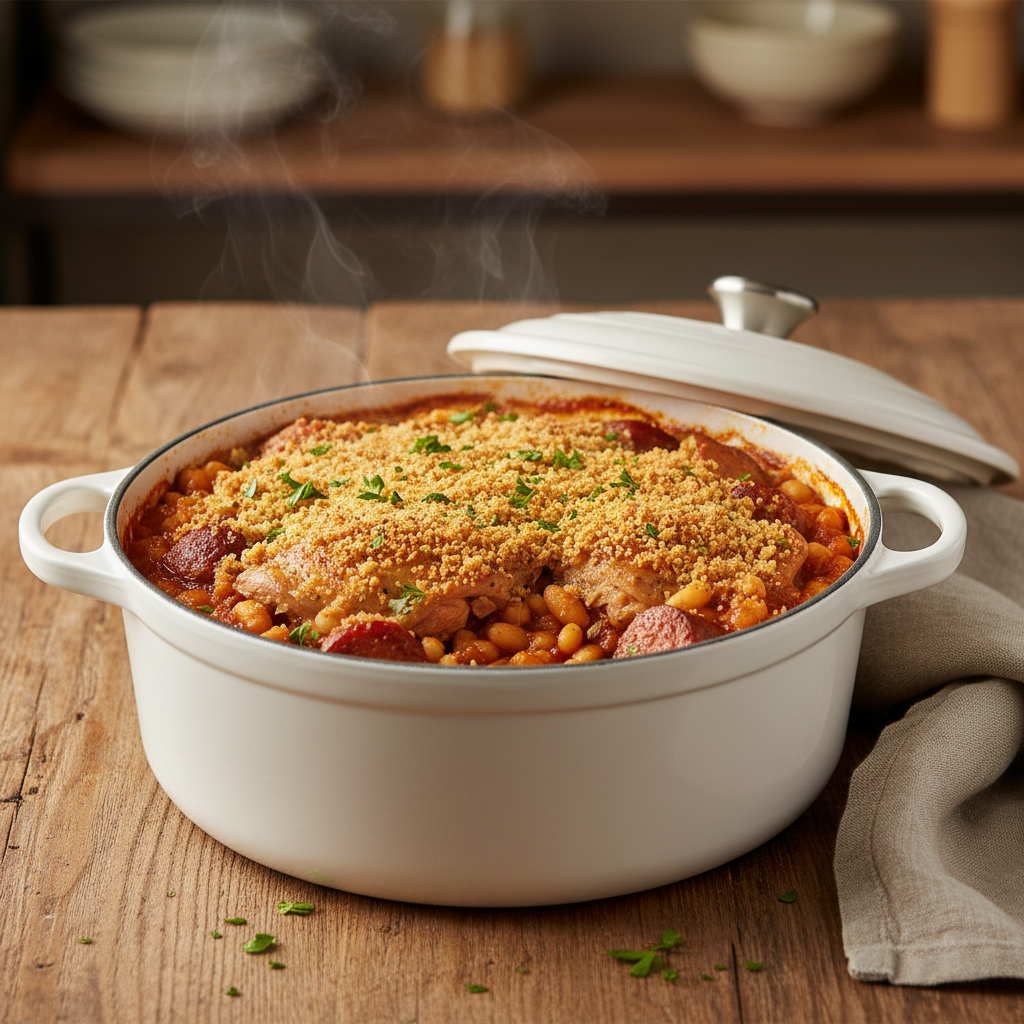
There are winter dinners that ask for speed, and then there is cassoulet, which asks for the opposite: a pot, a slow oven, and an afternoon that smells like bacon, herbs, and tomatoes long before anyone sits down to eat. Ina Garten Cassoulet is a rich, hearty French comfort dish built on white beans, tender chicken thighs, smoky sausage, and bacon, all slow-baked together until the sauce thickens and the breadcrumb topping turns golden and crisp. It is the kind of meal that makes a cold night feel generous, and it is also the kind of meal that tastes even better the next day, because the flavours keep developing overnight. This guide walks you through the full recipe exactly as it appears on Recipes Walay, with every ingredient, every step, expert tips, variations, serving ideas, and answers to the questions people actually ask before they make it.
Cassoulet sounds like a dish that belongs in a French country kitchen, and that is exactly where it comes from — a slow-cooked casserole from the south of France, traditionally made with white beans and whatever meats the household had on hand, baked slowly until everything becomes tender and the top turns crisp. Ina Garten’s version keeps that spirit and makes it manageable for a home cook: the beans are soaked overnight, the bacon and chicken are browned first so they flavour the whole pot, and the oven does the long, slow work of turning it into a single rich, hearty dish. The recipe takes 30 minutes of prep and 2 hours of cooking, it serves 6, and each serving is 520 kcal, so it suits a family dinner, a weekend gathering, or a winter table where you want one generous pot in the middle and everyone helping themselves. Remember the beans need soaking overnight, so plan a day ahead — but once the pot is in the oven, there is very little left to do.
The full recipe is on Recipes Walay at https://recipeswalay.com/ina-garten-cassoulet-recipe/
Why You Will Love Ina Garten Cassoulet
Some recipes earn their place through speed, and some through patience. This one earns it through patience, and the reward is a depth of flavour that fast cooking simply cannot reach. The beans become creamy, the chicken turns tender, the sausage and bacon give the whole pot a smoky richness, and the slow bake thickens the sauce until it coats everything. Most of the cooking time is hands-off: once the pot is covered and in the oven for 90 minutes, you can set the table, make a salad, and let the house fill with the smell of dinner.
The first reason to love this recipe is how generous it feels. It serves 6 from a single pot, and it is the kind of food that suits a table full of people — a family dinner, a weekend gathering, or a winter evening with friends. There is no fussy plating and no last-minute rush: the pot comes to the table, the topping is golden and crisp, and everyone takes as much as they want. The recipe itself says it works for gatherings and stores well for later, which tells you what kind of dish this is — one that is made to be shared, and one that does not punish you for making a full pot.
The second reason is how forgiving the method is. The steps are clear and friendly, the ingredients are simple, and the recipe tells you plainly what matters: soak the beans overnight, brown the meat well, use homemade stock if you can, let the cassoulet rest before serving, and taste and adjust the seasoning carefully. Follow those six tips and the dish almost takes care of itself. The long bake is the most forgiving part of all — an extra ten minutes in the oven will not ruin it, and the dish actually improves as it sits, so the timing pressure that comes with most dinners simply is not there.
The third reason is the texture. A good cassoulet has three completely different textures in one spoonful — the beans are soft and creamy, the chicken and sausage are tender and rich, and the breadcrumb topping is golden and crisp on top. That contrast is what makes the dish feel so satisfying, and it is also what makes it feel like a proper meal rather than a simple stew. The sauce ties it together: rich with tomatoes and stock, thickened by the slow bake, and seasoned with thyme and bay leaf so that every bite tastes of herbs and smoke and warmth.
What Is Ina Garten Cassoulet?
Cassoulet is a classic French slow-cooked casserole: white beans baked with meats — traditionally pork, sausage, and sometimes duck or chicken — in a rich, tomatoey sauce, with a breadcrumb topping that turns golden and crisp in the oven. The name comes from the cassole, the deep earthenware pot it was traditionally baked in, and the dish has been served in homes across the south of France for generations, because it turns simple, affordable ingredients into something deeply comforting. It has stayed popular for the same reason it became popular in the first place: it is filling, it feeds a crowd, and it tastes better the longer it cooks.
Ina Garten’s version keeps the classic structure and focuses on doing each part properly. The white beans are soaked overnight so they cook into a creamy base rather than staying hard in the middle. The bacon is cooked until crisp first, and the chicken thighs are browned in the bacon fat, so the flavour of both meats seasons the whole pot from the very beginning. The onion, carrots, and garlic are sautéed in the same pot, the tomato paste is cooked briefly to deepen its flavour, and then the tomatoes and chicken stock go in to make the sauce. Everything is nestled together — beans, sausage, bacon, herbs, and chicken — and baked covered for 90 minutes, then uncovered with a breadcrumb topping for 20 minutes so the top turns crisp and golden.
On Recipes Walay, the recipe is listed as a main course in the French cuisine tradition, and it serves 6 people. The card gives 30 minutes of prep time, 2 hours of cook time, and a total time of 2 hours and 30 minutes, with 520 kcal per serving. The dish is, in the recipe’s own words, rich, hearty, and perfect for family dinners and gatherings, and it feels timeless: slow, generous, and warming, the kind of food that makes a winter night feel like an occasion. That is exactly what a winter dinner should be.
Ingredients You Need for Ina Garten Cassoulet (with Quantities)
One of the best things about this recipe is how simple the shopping list is. There is nothing exotic here — beans, chicken, sausage, bacon, a few vegetables, and pantry staples — and every quantity below comes straight from the recipe card on Recipes Walay. The ingredients fall into three natural groups: the beans and meats, the vegetables and aromatics, and the sauce and topping.
For the beans and meats:
- 2 cups dried white beans, soaked overnight
- 4 chicken thighs, bone-in
- 2 cups cooked sausage slices
- 4 strips bacon, chopped
The beans are the heart of the dish, so they deserve the most attention. Two cups of dried white beans, soaked overnight, cook into the creamy base that makes cassoulet what it is, and the recipe’s first tip — soak the beans overnight for the best texture — is worth following exactly. Beans that have not soaked properly stay hard in the middle no matter how long they bake, and no amount of extra oven time will fix them. The chicken thighs are bone-in, which matters: the bone keeps the meat moist through the long bake and adds flavour to the sauce as it cooks. The sausage is already cooked — the recipe calls for 2 cups of cooked sausage slices, sliced and ready to go into the pot — and the bacon is chopped and cooked crisp at the start, so its fat can flavour everything that follows.
For the vegetables and aromatics:
- 1 large onion, diced
- 2 carrots, sliced
- 3 garlic cloves, minced
- 1 teaspoon dried thyme
- 1 bay leaf
- Salt to taste
- Black pepper to taste
The onion, carrots, and garlic are the aromatic base, cooked in the same pot after the bacon and chicken so they pick up all the browned flavour left behind. The thyme and the bay leaf are the herbs that give cassoulet its French character — dried thyme is what the recipe calls for, and one bay leaf is enough to scent the whole pot without overpowering it. Salt and black pepper are listed “to taste”, which means the recipe leaves the seasoning to you: the stock and the bacon already carry salt, so it is better to under-season early and correct at the end than to over-salt and have no way back. The recipe’s own tip says to taste and adjust the seasoning carefully, and that advice is worth taking seriously at the end of the bake.
For the sauce and topping:
- 1 cup crushed tomatoes
- 2 cups chicken stock
- 2 tablespoons tomato paste
- 1/2 cup fresh parsley, chopped
- 1 cup breadcrumbs
- 2 tablespoons olive oil
The sauce is built from crushed tomatoes, chicken stock, and tomato paste — a simple combination that becomes rich and deep after two hours in the oven. The tomato paste is cooked briefly in the pot before the liquid goes in, which takes the raw edge off it and deepens the flavour. The breadcrumbs and olive oil are the topping: mixed together and sprinkled over the pot for the final uncovered bake, they turn golden and crisp and give the dish its signature finish. The parsley is the garnish, scattered over the top at the end, and it adds a fresh green note that lifts the richness of the pot. If you want more winter dinner ideas built around the same kind of slow comfort, the winter stew collection on Recipes Walay is a good place to look: https://recipeswalay.com/easy-winter-stew-recipes/
A note on quantities: the beans are measured dry, before soaking, so do not be surprised when they swell overnight — 2 cups of dried beans will look like a lot more by morning, and that is exactly right. The sausage is measured cooked, so if you buy raw sausage, cook and slice it before you measure. And the stock matters more than it might seem: the recipe’s tip to use homemade stock if possible is there because the stock is the liquid the beans cook in for two hours, so a good stock will flavour every spoonful, while a thin one will leave the dish tasting flat.
Equipment You Need
You do not need any special equipment for cassoulet, and the list below is everything the recipe calls for. The large Dutch oven does most of the work — it goes from the stove to the oven, it browns the bacon and chicken, it holds the whole pot for the long bake, and it comes to the table for serving. A large skillet is there for any browning you prefer to do separately, though the Dutch oven can handle it all. A wooden spoon is for stirring the pot as the sauce comes together, and a sharp knife and cutting board are for the onion, carrots, garlic, and parsley.
- Large Dutch oven
- Large skillet
- Wooden spoon
- Sharp knife
- Cutting board
- Measuring cups and spoons
- Oven
The Dutch oven is worth a mention because it is the difference between a cassoulet that works and one that struggles. A heavy pot with a tight-fitting lid holds the heat evenly through the 90-minute covered bake, keeps the moisture in so the beans cook through, and then goes straight into the oven uncovered for the final crisping. A thin pot will scorch on the bottom and dry out on top, so if you have a heavy Dutch oven, this is the recipe to use it for. Make sure the lid fits well before you start, because a loose lid lets the steam escape and the beans will take much longer to soften. Have your measuring cups and spoons out before you start, because the steps move from browning to sauce-building fairly quickly, and you do not want to be measuring stock with one hand while stirring with the other.
How to Make Ina Garten Cassoulet Step by Step
The recipe gives 20 short steps, and this guide expands them into 12 clear stages so you can follow along without losing your place. The beans are soaked the night before, so the cooking day starts with the oven and the pot — and once the pot is covered and in the oven, the long bake does the rest. The whole dish takes about 2 hours and 30 minutes from the first step to the table, not counting the overnight soak.
Step 1: Soak the Beans Overnight
Put the 2 cups of dried white beans in a large bowl, cover them with plenty of cold water, and leave them to soak overnight. This is the step the whole dish depends on, and it is also the easiest to get wrong by skipping it: dried beans that have not soaked will not soften properly in the oven, and they will stay hard in the middle even after two hours of baking. Soaking lets the beans absorb water slowly and evenly, so they cook into a creamy texture instead of a chalky one. In the morning, drain the soaked beans thoroughly and set them aside. Do not cook them in the soaking water — fresh water, and later the stock, is what they should cook in.
Step 2: Preheat the Oven and Cook the Beans Until Slightly Tender
Preheat the oven to 350°F. Put the drained beans in a pot of fresh water, bring it to a boil, and cook the beans until they are slightly tender — not fully cooked, just softened enough that they have started to give. This is a head start, not the full cook: the beans will finish cooking in the Dutch oven during the long bake, in the stock and tomato sauce, which is where they pick up most of their flavour. If you cook them fully now, they will fall apart later and turn the cassoulet mushy, so pull them while they still have a little bite. Drain them and set them aside.
Step 3: Crisp the Bacon in the Dutch Oven
Heat the large Dutch oven over medium heat and add the 4 strips of chopped bacon. Cook the bacon until it is crisp, stirring now and then so the pieces brown evenly. This is the first layer of flavour in the pot, and it matters more than it looks: the bacon gives the dish its smoky depth, and the fat it leaves behind is what the chicken and the vegetables will cook in. Take your time and let the bacon get properly crisp — pale, floppy bacon will not give the pot the same richness. When it is crisp, lift the bacon out with a slotted spoon and set it aside, but leave every drop of the fat in the pot.
Step 4: Brown the Chicken Thighs in the Bacon Fat
Add the 4 bone-in chicken thighs to the same Dutch oven, skin side down first, in the bacon fat. Brown them well on all sides, turning them gently so each side gets a good golden colour. The recipe’s tip to brown the meat well for deeper flavour is aimed squarely at this step: proper browning is what gives the chicken its flavour, and it also leaves browned bits in the pot that will season the sauce later. Do not rush this on high heat, or the outside will burn before the inside has a chance to brown evenly. When the thighs are browned all over, lift them out and set them aside with the bacon. They do not need to be cooked through yet — they will finish cooking during the long bake.
Step 5: Sauté the Onion, Carrots and Garlic
Add the diced onion, sliced carrots, and minced garlic to the same pot, in the fat the bacon and chicken left behind. Sauté them over medium heat, stirring regularly, until the onion is soft and translucent and the carrots have started to soften. This is the aromatic base of the dish, and cooking it in the same pot means it picks up all the browned flavour the meats left behind. Give it a few minutes and do not let the garlic burn — garlic that has browned too far turns bitter, and there is no way to take that taste out of the sauce. If the pot seems dry, a small drizzle of olive oil will keep things moving.
Step 6: Stir in the Tomato Paste and Cook Briefly
Add the 2 tablespoons of tomato paste to the pot and stir it through the vegetables. Cook it briefly — a minute or two, stirring constantly — so the paste darkens slightly and loses its raw, sharp edge. This short cook matters more than it looks: raw tomato paste tastes tinny and acidic, but a minute in the hot pot deepens it into something rich and savoury, and that depth will carry through the whole two-hour bake. Keep the spoon moving so the paste does not stick to the bottom of the pot or catch, and do not let it brown too far.
Step 7: Stir in the Tomatoes and Chicken Stock
Now pour in the 1 cup of crushed tomatoes and the 2 cups of chicken stock, stirring as you go and scraping the bottom of the pot with your wooden spoon. This is the moment the sauce is made, and the scraping matters: the browned bits stuck to the bottom of the Dutch oven will dissolve into the liquid and give the sauce its colour and savoury depth. The stock should come to a gentle simmer, and the tomatoes will start to break down into the liquid. If the pot seems very full at this point, do not worry — the beans and the chicken will nestle in, and the long bake will thicken everything down.
Step 8: Add the Beans, Sausage, Bacon and Herbs
Stir in the par-cooked beans, the 2 cups of cooked sausage slices, and the crisp bacon you set aside earlier, along with the 1 teaspoon of dried thyme and the bay leaf. This is the moment the dish becomes a cassoulet rather than a collection of ingredients: everything goes into the same pot, the beans sit in the sauce where they will finish cooking, and the sausage and bacon spread their flavour through the liquid. Stir gently so the beans do not break apart, and make sure the thyme and bay leaf are mixed through rather than sitting on top.
Step 9: Season and Nestle the Chicken into the Pot
Season the pot with salt and black pepper, remembering that the bacon and the stock already carry salt, so start light — you can always adjust at the end, and the recipe’s tip to taste and adjust the seasoning carefully is aimed at exactly this moment. Then nestle the browned chicken thighs into the mixture, pushing them down gently so they sit mostly covered by the beans and sauce, with the skin facing up. The chicken will finish cooking in the oven, surrounded by the sauce, which is what keeps it moist through the long bake. Try to spread the thighs evenly through the pot rather than crowding them on one side, so everything cooks at the same rate.
Step 10: Cover and Bake for 90 Minutes
Put the lid on the Dutch oven and slide it into the preheated 350°F oven. Bake, covered, for 90 minutes. This is the long, slow heart of the dish, and it is almost entirely hands-off: the beans finish cooking in the sauce, the chicken becomes tender, the flavours come together, and the sauce thickens as the beans release their starch. Do not be tempted to lift the lid every ten minutes to check — the pot needs its trapped steam and steady heat, and every peek lets both escape. Set a timer, and use the time to make a salad, slice the bread, and set the table.
Step 11: Mix the Breadcrumbs with Olive Oil and Sprinkle Over the Top
After 90 minutes, take the pot out of the oven and lift the lid. In a small bowl, mix the 1 cup of breadcrumbs with the 2 tablespoons of olive oil until the crumbs are evenly coated, then sprinkle the mixture evenly over the top of the cassoulet. This is the topping that makes the dish a cassoulet: the crumbs will bake into a golden, crisp crust that contrasts with the soft beans underneath. Spread them in an even layer rather than piling them in the middle, and try to cover the surface from edge to edge so every serving gets some of the crisp topping. The recipe’s tip is clear that the crisp topping adds extra texture, and it is worth taking a moment to get the layer even.
Step 12: Bake Uncovered, Rest and Serve
Put the pot back in the oven, uncovered, and bake for 20 minutes more, until the breadcrumb topping is golden and crisp and the sauce is bubbling gently at the edges. When it comes out, garnish with the 1/2 cup of chopped fresh parsley, scattered over the top. Then let the cassoulet rest before serving — the recipe’s tip says so plainly, and it matters: a few minutes of resting lets the sauce settle and thicken slightly, the beans firm up just enough to hold their shape, and the topping stays crisp instead of going soggy. Serve it warm and hearty, straight from the pot, with the topping spooned over each portion so everyone gets some of the crunch.
Expert Tips for Perfect Ina Garten Cassoulet
The recipe gives six tips, and each one protects a different part of the dish. Together they are the difference between a good cassoulet and a great one, and they are all easy to follow once you know why they matter.
Soak the beans overnight for the best texture. This is the first tip in the recipe, and it is the one that matters most, because the beans are the heart of the dish. Properly soaked beans cook into a creamy, tender base; unsoaked beans stay hard and chalky in the middle no matter how long they bake. Put them in water the night before, use plenty of water because they will swell, and drain them thoroughly in the morning. If you forget to soak them, you will need to boil them longer in the par-cook step, and even then the texture will not be quite the same.
Brown the meat well for deeper flavour. Both the bacon and the chicken thighs need proper browning, and this is not a step to rush. Well-browned meat gives the pot its savoury depth, and the browned bits left in the Dutch oven are what season the sauce. Take your time over medium heat, turn the pieces so every side gets colour, and do not crowd the pot — if the thighs are packed in too tightly they will steam instead of browning, and you will lose the flavour you are trying to build.
Use homemade stock if possible. The stock is the liquid the beans cook in for two hours, so a good stock will flavour every spoonful of the dish, while a thin, salty shop-bought stock will leave it tasting flat or too salty. If you have homemade chicken stock, this is the recipe to use it in. If you are using shop-bought stock, choose a low-sodium one so you can control the seasoning yourself, and taste the sauce before you add any extra salt at the end.
Let the cassoulet rest before serving. A few minutes of resting after the pot comes out of the oven lets the sauce settle and thicken, the beans firm up slightly, and the flavours come together. It also lets the topping stay crisp — if you serve it the second it comes out of the oven, the steam will soften the crumbs. Five to ten minutes on the counter, lid off, is enough, and the dish will still be warm and hearty when it reaches the table.
Taste and adjust the seasoning carefully. The bacon, the sausage, and the stock all bring salt to the pot, so the right amount of seasoning can only be judged at the end, once everything has cooked together. Taste the sauce after the bake, before you garnish and serve, and adjust the salt and pepper then. Add a little at a time and stir it through — you can always add more, but you cannot take salt out of a pot that is already seasoned.
Crisp topping adds extra texture. The breadcrumb topping is not decoration: it is the contrast that makes the dish work, the golden crunch against the soft beans and tender chicken. Mix the crumbs evenly with the olive oil so they crisp rather than burning in patches, spread them in an even layer, and give them the full 20 minutes uncovered so they turn properly golden. If the topping is browning too fast, you can cover the pot loosely with foil for the last few minutes, but a well-oiled crumb layer should crisp evenly on its own.
One more habit that helps: have everything measured and ready before you start. The steps move from browning to sauce-building fairly quickly, and you do not want to be chopping carrots with one hand while the garlic burns in the pot. A few minutes of preparation at the start makes the whole cook calmer and the result better.
Variations to Try
The recipe as written is the classic version, and it is worth making exactly as it stands the first time. Once you know it, though, the dish is forgiving, and there are a few simple twists that stay true to the original while giving it a different character. These are cook’s variations, not part of the recipe card — the quantities and method above are the recipe’s, and the ideas here are ways to play with it once you are comfortable.
Use a different white bean. The recipe calls for dried white beans, and any good white bean will work in the same method — cannellini beans are creamy and hold their shape well, navy beans are smaller and cook a little faster, and Great Northern beans sit somewhere in between. Keep the overnight soak and the par-cook exactly the same, and let the bean be the only thing that changes, so you can taste the difference properly. Whichever bean you choose, soak it overnight — that tip applies to all of them.
Try a different cooked sausage. The recipe calls for cooked sausage slices, and the same method works well with a smoky kielbasa for a deeper, smokier pot, or with a mild Italian sausage for a gentler flavour. Keep the quantity the same — 2 cups, sliced — and keep the rest of the method unchanged, so the sausage is the only variable. The bacon and the chicken already bring a lot of flavour, so choose a sausage that complements them rather than competing with them.
Add a splash of white wine. A small splash of dry white wine, poured in with the tomatoes and stock and allowed to simmer for a minute before the beans go in, adds a gentle acidity that lifts the richness of the pot. It is a small change and it is not in the recipe card, so keep it modest — a quarter of a cup is plenty — and let it cook down before the lid goes on, so the alcohol cooks off and only the flavour remains. For more winter dinner ideas built around the same kind of slow comfort, the Gordon Ramsay winter recipes roundup is worth a look: https://recipeswalay.com/easy-gordon-ramsay-winter-recipes-for-cozy-nights/
Make it a little spicier. A pinch of chilli flakes or a little smoked paprika, stirred in with the thyme, gives the pot a gentle warmth that suits the smoky bacon very well. Add it with the herbs so it has the full bake to mellow into the sauce, and start with a small amount — you can always add more at the end, but you cannot take heat out of a pot that is already spicy. This is a good option when you want the dish to feel a little more modern without changing its character.
Use panko for a lighter topping. The recipe calls for 1 cup of breadcrumbs mixed with olive oil, and panko crumbs will give you a lighter, crunchier topping that browns a little faster. If you use panko, keep the same quantity and the same olive oil, spread the layer evenly, and check it a few minutes early, because panko can go from golden to burnt more quickly than ordinary breadcrumbs. For another slow-cooked winter main built the same way, the crockpot pot roast guide is worth a look: https://recipeswalay.com/easy-ina-garten-crockpot-pot-roast-for-winter-nights/
What to Serve with Ina Garten Cassoulet
Cassoulet is a complete meal on its own, but the right side dish makes the plate feel finished. The recipe suggests three sides, and each one works for a different reason. Beyond those, the Recipes Walay winter collections have plenty of ideas for building a fuller table around this dish.
Crusty French Bread. Warm bread pairs perfectly with cassoulet, and it is the most natural partner of the three. It soaks up the rich sauce, and its crisp crust and soft inside complement the stew. A good loaf, sliced thick and served warm, is all it needs — the bread is there to scoop up the sauce and to make sure none of the flavour is left in the pot. If you are serving a crowd, put the loaf on the table and let everyone tear off what they want, because a cassoulet dinner is meant to feel generous and relaxed.
Simple Green Salad. A fresh salad adds balance, and it is the lightest of the three suggestions. A light vinaigrette cuts the richness of the pot, and the crisp leaves keep the meal feeling refreshing rather than heavy. It does not need to be complicated — a few leaves, a simple dressing, and perhaps some sliced cucumber are enough — because the salad is there to refresh the palate between bites of rich beans and sausage, not to compete with them. It is the best choice when you want the meal to feel lighter, or when you are serving guests who prefer something fresh on the side.
Roasted Green Beans. They add colour and crunch, and their mild taste works well with the hearty dish. Roasted until their edges are lightly crisp, green beans add a gentle freshness that lightens the pot without taking anything away from it. A tray of green beans can roast in the oven while the cassoulet bakes, so they add almost no extra work to the meal, and they bring a bright green note to a table that is otherwise brown and golden.
For a fuller winter table, the recipe’s own suggestions are only the start. A bowl of mashed potatoes is a generous alternative side when you want something soft and creamy next to the crisp topping — the mashed potatoes guide on the site covers exactly that: https://recipeswalay.com/easy-mashed-potatoes-for-thanksgiving/ — and the winter potato collection has more ideas in the same spirit: https://recipeswalay.com/easy-winter-potato-recipes/. A warming winter casserole makes a similar partner on a cold night — see https://recipeswalay.com/easy-winter-casserole-recipes/ — and if you are building a whole winter menu, the beef bourguignon guide (https://recipeswalay.com/easy-ina-garten-beef-bourguignon-for-winter-nights/) is another slow-cooked classic that sits naturally beside cassoulet.
Make-Ahead and Storage
Here the guide has to be honest about what the recipe does and does not say. The single recipe on Recipes Walay gives no specific storage guidance at all — no refrigerator or freezer duration, no container, and no reheating method — and this guide will not invent any. What the recipe does say, in its introduction and conclusion, is that the cassoulet tastes even better later, that leftovers develop a richer flavour overnight, and that the dish stores well for later. That is the whole of the storage advice the recipe provides, and it is worth taking seriously: this is a dish that improves as it sits, because the beans keep absorbing the sauce and the flavours keep coming together.
That is also, in practice, how the dish is at its best for a second meal. If you make a full pot for six and have some left over, the honest advice is to let it cool, keep it covered in the refrigerator, and reheat it gently on the stove or in a moderate oven until it is hot all the way through — but the recipe does not give a number of days, a reheating temperature, or a freezing instruction, so this guide does not state one. Do not guess at a storage time the recipe never gave, and do not freeze it on the strength of this guide alone, because the recipe does not say whether the beans and the topping will hold up to freezing.
If you do need to plan ahead, the practical approach is to prepare rather than to pre-cook: soak the beans the night before, chop the onion, carrots, and garlic earlier in the day, slice the sausage, and measure out the tomatoes, stock, and breadcrumbs, so that the actual cooking — which takes 2 hours and 30 minutes — can happen in one smooth run. That way nothing is compromised, and the meal still comes together without a rush. And if you are cooking for a gathering, remember that the dish is meant to be made in a full pot: the recipe serves 6, and the flavours are at their best when the pot is full and the beans have plenty of sauce to cook in.
Nutrition and Calories
The recipe card gives one nutrition figure, and it is the only one this guide will report: each serving of Ina Garten Cassoulet is 520 kcal, for 6 servings. The single recipe does not list protein, fat, carbohydrates, fibre, or sodium, and this guide does not estimate or invent those numbers. If you need the full breakdown for dietary reasons, the honest answer is that the recipe does not provide it, and the 520 kcal per serving is the figure the recipe itself stands behind.
What can be said fairly is where those calories come from. The beans make up the bulk of the dish and bring fibre and substance, the chicken thighs and sausage and bacon bring the richness and the protein, and the breadcrumb topping adds a modest amount of carbohydrate and fat from the olive oil. The sauce — built on tomatoes, stock, and tomato paste — is the lightest element on the plate, and the green salad suggested as a side adds freshness and crunch for very few calories, which is one reason the recipe pairs it with the dish. If you want a lighter version, the most honest change is in the meats themselves: less bacon and a leaner sausage will lower the richness of the plate more than any change to the beans or the sauce, and the method stays exactly the same.
Occasions to Serve Ina Garten Cassoulet
This is a dish that fits almost any occasion, and the recipe says so plainly: it is perfect for family dinners and gatherings, and it works for any winter night when something warm and filling is exactly what everyone wants. Its real home, though, is the slow weekend and the full table. A pot of cassoulet is exactly what a cold night calls for, and it is no accident that this guide is written for winter nights — the dish is warming, filling, and unhurried, and it turns an ordinary evening into something worth sitting down for together.
For a relaxed family dinner, it is hard to beat. The ingredients are affordable, the method is forgiving, and the pot feeds six without any fuss, which is not something you can say about every dinner. It also scales well in spirit, if not in exact numbers: the recipe serves 6, and a single pot is the right size for a family table, because nothing in the method depends on exact pan sizes. For casual guests, it works because it looks generous and tastes like real cooking, and because it can be served family-style — the pot in the middle of the table, a loaf of bread beside it, and everyone helping themselves — so the meal feels relaxed rather than formal.
For a weekend meal, cassoulet is a good slow-cooked centrepiece that does not demand constant attention, leaving you free to enjoy the afternoon while the oven does the work. And for a winter menu built around comfort food, it sits naturally alongside the other winter guides on the site — the chicken stew and biscuits guide (https://recipeswalay.com/easy-ina-garten-chicken-stew-and-biscuits-for-winter-nights/) is a similar kind of one-pot comfort, and the bangers and mash guide (https://recipeswalay.com/easy-ina-garten-bangers-and-mash-for-winter-nights/) is another classic that belongs on the same kind of table. The three together give you a small collection of winter dinners that are all easy, generous, and made for cold nights.
FAQs about Ina Garten Cassoulet
Do I really need to soak the beans overnight?
Yes, and this is the one step you should not skip. The recipe calls for 2 cups of dried white beans, soaked overnight, and its first tip is to soak the beans overnight for the best texture. Dried beans that have not soaked will not soften properly in the oven, and they will stay hard in the middle even after two hours of baking. Soaking lets the beans absorb water slowly and evenly, so they cook into a creamy texture. Put them in plenty of cold water the night before, drain them thoroughly in the morning, and do not cook them in the soaking water.
What kind of sausage should I use?
The recipe calls for 2 cups of cooked sausage slices, and it does not name a particular variety, so this guide does not invent one. Use a cooked sausage you like and that you know will hold up in a long bake — slice it before you measure, and keep the quantity at 2 cups. A smoky sausage will deepen the pot, a mild one will let the chicken and bacon lead, and either will work, because the sausage is one voice in a pot that already has several. What matters is that it is cooked before it goes in, so it does not release raw fat into the sauce during the bake.
Can I make cassoulet ahead of time?
The single recipe gives no specific make-ahead or storage durations, so this guide cannot promise a method the recipe does not provide. What the recipe does say is that the cassoulet tastes even better later, that leftovers develop a richer flavour overnight, and that the dish stores well for later. That is the recipe’s own advice, and it means the dish is well suited to being made a day ahead and reheated gently — but the recipe does not give a number of days, a reheating temperature, or a freezing instruction, so this guide does not state one. If you need to plan ahead, prepare rather than pre-cook: soak the beans, chop the vegetables, and measure everything, so the 2 hour 30 minute cook can happen in one smooth run.
Why is the cassoulet baked covered first, then uncovered?
The covered bake and the uncovered bake do two different jobs. Covered for 90 minutes, the pot traps steam and heat, so the beans finish cooking in the sauce, the chicken becomes tender, and the flavours come together without the sauce drying out. Uncovered for 20 minutes with the breadcrumb topping, the top of the dish gets direct heat, so the crumbs turn golden and crisp while the sauce bubbles gently at the edges. If you baked it uncovered the whole time, the sauce would reduce too far and the beans would dry out; if you baked it covered the whole time, the topping would never crisp. The two stages are what give the dish both its soft, rich base and its crunchy top.
What if I do not have a Dutch oven?
The recipe calls for a large Dutch oven, and it is the right tool because it goes from the stove to the oven, holds heat evenly, and has a tight-fitting lid. If you do not have one, the closest substitute is any heavy, oven-safe pot with a tight-fitting lid — a heavy casserole dish with a lid, or a large oven-safe pot that can go from the burner to the oven. This is a cook’s substitution, not part of the recipe card, and it comes with a warning: a thin pot will scorch on the bottom and dry out on top, so whatever you use, it should be heavy, and the lid should fit well. A slow cooker will not give you the crisp breadcrumb topping, so it is not a good substitute for this dish.
How do I know when the cassoulet is done?
The recipe judges this by time and by appearance rather than by a temperature reading: 90 minutes covered, then 20 minutes uncovered, at 350°F. At the end of that time the beans should be tender all the way through, the sauce should be thick and rich rather than watery, the chicken should be tender, and the breadcrumb topping should be golden and crisp. No internal temperature is given in the recipe, so this guide does not invent one. The most useful check is the beans: spoon one out and taste it. If it is soft and creamy all the way through, the pot is ready — and remember to let it rest for a few minutes before serving, so the sauce settles and the topping stays crisp.
Final Thoughts
Cassoulet is proof that the slowest dinners are often the most rewarding ones, and Ina Garten’s version is a reminder of why this dish has lasted so long. It asks for so little that is fancy — beans, chicken, sausage, bacon, and a few vegetables — and gives back so much: a pot that is warm, filling, and satisfying, with three textures that belong together and a sauce that ties them into a single meal. With basic ingredients and a little patience, you can make something that tastes like a proper French country dinner, and if you follow the recipe’s six tips carefully — soaked beans, well-browned meat, good stock, a proper rest, careful seasoning, and a crisp topping — you will get it right the first time.
What makes this recipe worth keeping is not just how good it is, but how generous it is. The method does not depend on luck or on special equipment, and the recipe tells you plainly what matters: good ingredients, patient cooking, and a slow bake in the same pot the meats browned in. Those are habits that will serve you well in any kind of cooking, and this recipe is a gentle way to learn them. It also gives you a dinner that improves with time, which is a rare and useful thing: a pot that tastes even better the next day is a pot that earns its place in a busy week.
Try this Ina Garten Cassoulet Recipe once, and it will become a favourite comfort food at home — a main course that turns an ordinary winter night into something worth sitting down for, and a recipe you will come back to whenever you want something slow, warm, and done properly.