

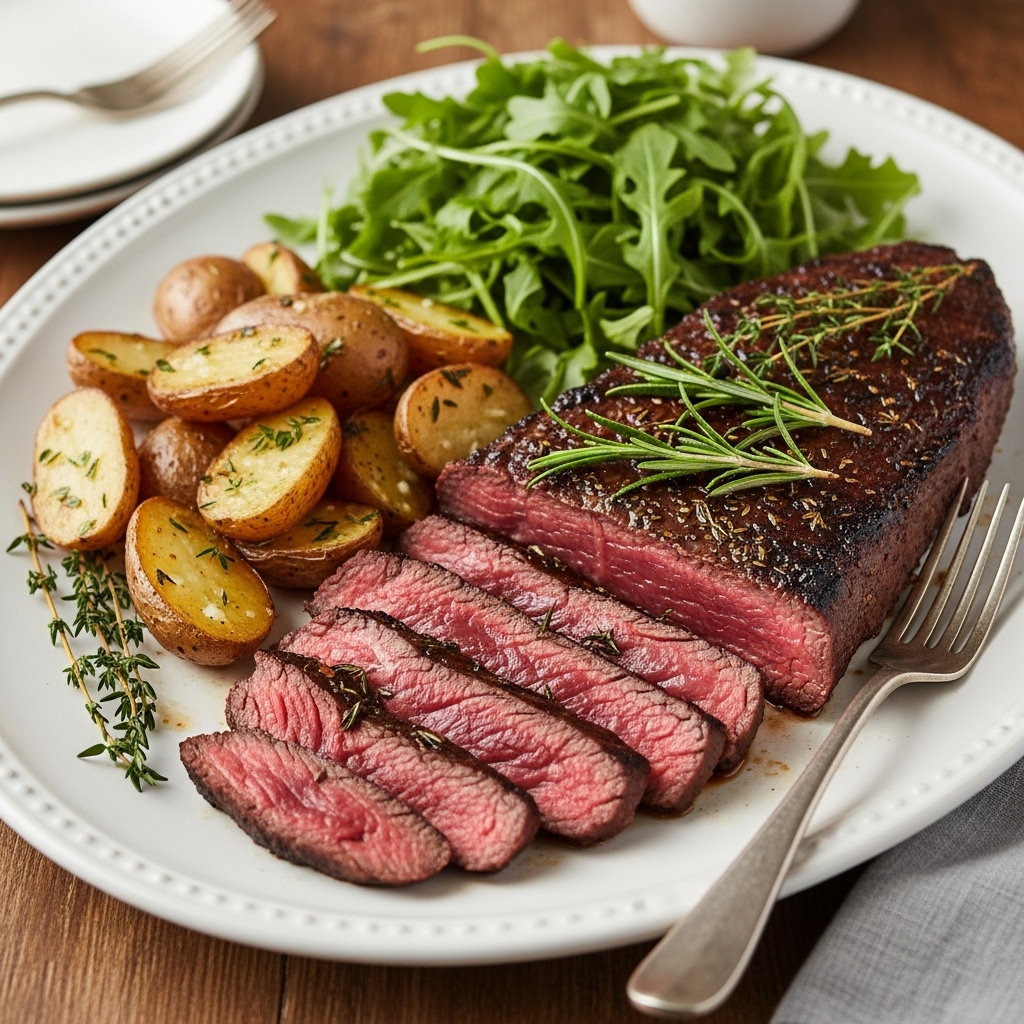
There are Christmas dinners that ask for a whole day in the kitchen, and then there is flank steak, which asks for ten minutes of preparation, two hours in the fridge, and eight minutes on a hot grill — and rewards you with something that tastes like it came from a proper steakhouse. Ina Garten Flank Steak is elegant yet easy: a lean cut of beef marinated in olive oil, red wine vinegar, Dijon mustard, garlic, and fresh rosemary and thyme, grilled quickly over high heat until the outside is crusted and the inside is juicy, then rested and sliced thinly against the grain. It is the kind of main course that makes a holiday table feel special without keeping the cook away from the table, and it is also the kind of recipe that works just as well on a busy weeknight as it does on Christmas Day. This guide walks you through the full recipe exactly as it appears on Recipes Walay, with every ingredient, every step, expert tips, variations, serving ideas, and answers to the questions people actually ask before they make it.
Flank steak is one of those cuts that sounds too simple to need a guide, until you have eaten one where the crust is dark and flavourful, the slices are tender rather than chewy, and the marinade has soaked all the way through — and then you realise the difference is in the details. The secret, as the recipe puts it, is proper marination time, high heat, and resting: two hours in the marinade, four minutes a side on a hot grill, and a rest under foil so the juices settle before the knife ever touches the meat. The recipe takes 10 minutes of prep and 8 minutes of cooking, it serves 4, and each serving is 420 kcal, so it fits easily into a Christmas dinner or a weeknight meal. There is no fancy equipment and nothing you need to buy specially — a grill pan or an outdoor grill, a bowl, a whisk, and a sharp knife will do the job. Remember that the two-hour marinade is on top of the 18 minutes of prep and cooking, so plan for it — but once the steak is in the fridge, there is very little left to do.
The full recipe is on Recipes Walay at https://recipeswalay.com/ina-garten-flank-steak-recipe/
Why You Will Love Ina Garten Flank Steak
Some recipes earn their place through drama, and some through reliability. This one manages both, which is why it is such a useful main course to have in your collection. It takes just 10 minutes of hands-on prep, the fridge does the work for two hours, and the grill finishes the job in eight minutes, so it is easy to fit into a Christmas dinner where the oven is already busy with everything else. Most of that time is waiting, not working, and nothing needs to be watched every second.
The first reason to love this recipe is the flavour. A good flank steak has a deep, beefy taste that a marinade can build on, and this one is a classic: olive oil carries the flavour, red wine vinegar adds a gentle sharpness, Dijon mustard gives it body, garlic adds savouriness, and fresh rosemary and thyme bring a bright, herby note. Two hours is enough for the marinade to soak into the meat without overpowering it, and the high heat of the grill adds a dark, caramelised crust that tastes of smoke and char. That contrast — the crust on the outside, the juicy meat inside — is what makes the dish feel like a steakhouse meal rather than a quick fix.
The second reason is how easy it is to get right. The steps are clear and friendly, the ingredients are pantry staples, and the recipe tells you plainly what matters: always slice against the grain, rest the steak so it stays juicy, do not overcook it, use fresh herbs, and use high heat for a great crust. Follow those five tips and the dish almost cooks itself. It works for a Christmas dinner, and it also suits a busy weeknight, because it looks elegant and tastes like you spent far longer on it than you did.
The third reason is versatility. Flank steak feels special but still practical, and the dish works for any occasion, though it truly shines when you want a main course that is impressive without being heavy or complicated. It is rich without being fussy, quick without being rushed, and it suits a quiet dinner for four just as well as a holiday table. Once you have made it, it becomes one of those recipes you return to whenever you want a steak dinner that everyone at the table will enjoy — and because it scales so easily, it is just as good for guests as it is for family.
What Is Ina Garten Flank Steak?
Flank steak is a lean, flat cut of beef taken from the lower belly of the cow, and it has long been prized by cooks who know it: it is affordable, it takes a marinade beautifully, and it cooks in minutes. Its only weakness is that it can turn tough if it is overcooked or sliced the wrong way, and this recipe is built entirely around solving those two problems. The marinade softens and flavours the meat, the high heat sears the outside quickly before the inside can dry out, and the slicing — thinly, against the grain — is what turns a firm cut into tender, easy bites.
Ina Garten’s version keeps the classic structure and focuses on doing each part properly. The marinade is whisked together from olive oil, red wine vinegar, and Dijon mustard, with garlic, rosemary, thyme, salt, and pepper stirred through, and the steak sits in it for two hours in the fridge. The grill is preheated to high heat, the steak is grilled four minutes per side, and then it is transferred to foil to rest, so the juices settle back into the meat before it is sliced. Nothing is rushed, and nothing is overcomplicated — the recipe trusts good ingredients and a hot grill.
On Recipes Walay, the recipe is listed as a main course in the American cuisine tradition, and it serves 4 people. The card gives 10 minutes of prep time, 8 minutes of cook time, and a total time of 18 minutes, with 420 kcal per serving — and that total does not include the two hours the steak spends marinating, which is waiting time rather than working time. The dish is, in the recipe’s own words, elegant yet easy, and it feels timeless: simple food done properly, impressive without stress, and a reminder that the best Christmas mains are often the simplest ones. That is exactly what a holiday dinner should be.
Ingredients You Need for Ina Garten Flank Steak (with Quantities)
One of the best things about this recipe is how short the shopping list is. There are only nine ingredients, every quantity below comes straight from the recipe card on Recipes Walay, and most of it is probably already in your kitchen. The ingredients fall into two natural groups: the steak itself, and the marinade that flavours it.
For the steak:
- 2 pounds flank steak
The steak is the star of the dish, so this is the one place where quality matters most. Two pounds is the right amount for four generous servings, and the recipe’s advice is to choose a good piece of flank steak with a nice, even thickness, so it cooks at the same rate from one end to the other. Flank steak is naturally lean, which is why the marinade and the resting matter so much — there is very little fat to keep it moist, so the oil in the marinade and the rest under foil are what protect the juiciness. When you buy it, look for a piece that is deep red with a little marbling, and avoid any piece that looks grey or dried out at the edges. If your butcher has a good flank steak, that is the one to buy.
For the marinade:
- 1/3 cup olive oil
- 2 tablespoons red wine vinegar
- 2 cloves garlic, minced
- 1 tablespoon Dijon mustard
- 1 tablespoon fresh rosemary, chopped
- 1 tablespoon fresh thyme, chopped
- 1 teaspoon kosher salt
- 1/2 teaspoon black pepper
The marinade is a classic combination, and each ingredient has a job. The olive oil carries the flavour into the meat and keeps the surface from drying out on the grill. The red wine vinegar adds a gentle acidity that brightens the beef and helps the marinade soak in. The Dijon mustard gives the marinade body and a mild sharpness, and it also helps the oil and vinegar hold together as an emulsion rather than separating. The garlic adds savouriness, and the fresh rosemary and thyme are the herbs that give the steak its bright, aromatic character — the recipe’s tip to use fresh herbs for the best flavour is aimed squarely at them, and dried herbs will not give you the same result. The salt and pepper season the meat all the way through during the two hours in the fridge. If you want more holiday main course ideas in the same spirit, the Thanksgiving beef collection on Recipes Walay is a good place to look: https://recipeswalay.com/easy-thanksgiving-beef-recipes-for-the-holiday-table/
A note on quantities: the salt is a full teaspoon of kosher salt, which is the right amount for two pounds of beef going into a two-hour marinade — the salt needs time to work its way into the meat, and a smaller amount would leave the centre under-seasoned. The rosemary and thyme are each a full tablespoon, chopped fresh, and that generous amount is what makes the herbs a real flavour in the dish rather than a garnish. Do not be tempted to cut the oil down: the third of a cup is what coats the steak evenly and keeps it from sticking to the grill, and most of it stays in the dish rather than on the plate.
Equipment You Need
You do not need any special equipment for flank steak, and the list below is everything the recipe calls for. A grill pan or an outdoor grill does the cooking — either one will work, as long as it can get properly hot. A mixing bowl and a whisk are for the marinade, and a sharp chef’s knife is for slicing the steak thinly against the grain, which is the step that makes the meat tender.
- Sharp chef’s knife
- Cutting board
- Measuring cups
- Measuring spoons
- Mixing bowl
- Whisk
- Grill pan or outdoor grill
- Tongs
- Aluminum foil
- Serving platter
The grill pan is worth a mention because it is the difference between a steak with a proper crust and one that is merely cooked. A heavy grill pan holds heat well and gives you the dark, caramelised marks that make flank steak look and taste like it came off a real grill, and it works on a stove in any weather, which matters on a Christmas evening. If you are using an outdoor grill, make sure it is preheated to high heat before the steak goes on — the recipe is explicit about this, and a grill that is not hot enough will steam the steak instead of searing it. The sharp knife matters just as much: flank steak must be sliced thinly against the grain, and a dull knife will tear the meat instead of cutting it cleanly, which ruins the tenderness the whole recipe is built around. Have your measuring cups and spoons out before you start, because the marinade comes together in a couple of minutes, and you will want everything measured before the whisking begins.
How to Make Ina Garten Flank Steak Step by Step
The recipe gives 12 steps, and this guide follows them in order, expanding each one so you can follow along without losing your place. The steak marinates for two hours, so start that first — and once the steak is in the fridge, the rest of the meal is eight minutes on the grill and a short rest. The whole dish takes 18 minutes of active time from the first step to the table, not counting the marinade.
Step 1: Place the Steak on a Clean Cutting Board
Place the 2 pounds of flank steak on a clean cutting board. This is the starting point for everything that follows, and it is worth doing properly: the board should be clean and dry, with enough space around the steak to work, and the steak should be patted dry with paper towels before the marinade goes on. A wet surface will stop the marinade from clinging to the meat, and it will also stop the grill from searing properly later, because the heat will spend itself boiling off water instead of browning the surface. Take a moment to check the steak over — trim away any loose silverskin or excess fat if there is any, and make sure the piece lies flat so it marinates and grills evenly.
Step 2: Whisk the Oil, Vinegar and Mustard Together
In the mixing bowl, whisk the 1/3 cup of olive oil, the 2 tablespoons of red wine vinegar, and the 1 tablespoon of Dijon mustard together until they come together into a smooth, slightly thickened mixture. The mustard is doing real work here: it helps the oil and the vinegar hold together as an emulsion rather than separating into two layers, which means the marinade will coat the steak evenly instead of sliding off in patches. Whisk firmly for thirty seconds or so, until the mixture looks uniform and a little cloudy, and do not worry if it is not perfectly smooth — it will come together fully once the rest of the ingredients go in.
Step 3: Add the Garlic, Herbs, Salt and Pepper
Add the 2 cloves of minced garlic, the tablespoon of chopped fresh rosemary, the tablespoon of chopped fresh thyme, the teaspoon of kosher salt, and the half teaspoon of black pepper to the bowl, and whisk everything together. The herbs should be chopped finely enough to spread through the marinade rather than sitting in clumps, and the garlic should be minced small so it distributes evenly over the surface of the meat. Stir until the herbs and garlic are suspended through the oil and vinegar rather than floating on top, and give the marinade a taste — it should be bright, herby, and well seasoned, because this is the flavour the steak will carry into the grill.
Step 4: Pour the Marinade Over the Steak Evenly
Pour the marinade over the steak, turning the steak once or twice so that both sides are coated, and use your hands or a brush to spread it evenly across the whole surface. Flank steak is a flat cut, so it takes a marinade very well, but only if the marinade actually reaches the meat — any dry patch will stay unflavoured and will also stick to the grill later. Make sure the edges and the thinner end are coated too, and if you are marinating in a shallow dish, spoon some of the marinade from the bottom back over the top so nothing is left sitting in a puddle while the top stays dry.
Step 5: Cover and Refrigerate for Two Hours
Cover the steak and refrigerate it for two hours. This is the step the whole recipe is built around, and it cannot be rushed: the recipe’s own explanation says it focuses on proper marination time, and two hours is what the marinade needs to soak into the meat and season it all the way through. Less time and the centre of the steak will taste plain; much more time and the vinegar will start to break down the surface of the meat and make it mushy. Two hours is the right balance. Cover the dish tightly — with cling film or a lid — so the fridge does not dry out the surface, and turn the steak once halfway through if you remember, so both sides spend time in the marinade.
Step 6: Preheat the Grill to High Heat
About ten minutes before the two hours are up, preheat the grill to high heat — an outdoor grill on its highest setting, or a grill pan over high heat on the stove. This is not a step to do halfway: the recipe is explicit that the grill should be at high heat, because flank steak needs a fast, fierce sear to develop its crust before the inside overcooks. A grill that is not hot enough will steam the steak instead of searing it, and you will end up with grey, tough meat instead of a dark, caramelised crust. Give the grill pan a good five minutes to get properly hot, and flick a drop of water on it to test — it should sizzle and evaporate immediately.
Step 7: Remove the Steak and Discard the Excess Marinade
Take the steak out of the fridge and lift it out of the marinade, letting the excess drip off back into the dish. Discard the excess marinade — do not reuse it as a sauce, because it has been in contact with raw beef for two hours and is not safe to serve. Do not wipe the steak dry, though: a thin coating of marinade is what will help the crust form on the grill, and the oil in it will keep the meat from sticking. Let the steak sit for a few minutes while the grill finishes heating, so the chill comes off the surface slightly — a steak straight from the fridge will cool the grill down and sear less evenly.
Step 8: Grill the Steak Four Minutes per Side
Place the steak on the hot grill and grill it for four minutes per side. Do not move it around once it is down: leave it alone for the full four minutes so the crust has time to form, and only then turn it once with the tongs. Four minutes a side is the recipe’s timing for a steak of this thickness, and it will give you a well-seared outside and a juicy, pink centre — but thickness varies, so use the time as a guide and the look of the meat as your check: the outside should be dark and caramelised, with clear grill marks, and the steak should feel firm but still springy when pressed. If your steak is unusually thick, it may need a minute more per side; if it is thin, a minute less.
Step 9: Cook Until Desired Doneness
The recipe says to cook until your desired doneness, and that is honest advice for a cut that people like at different levels. The four minutes a side in the previous step is the recipe’s own timing, and it lands most steaks in the medium-rare to medium range, which is where flank steak is at its best — juicy, tender, and still pink in the middle. No internal temperature is given in the recipe, so this guide does not invent one. The practical test is the feel of the meat: a steak that springs back quickly when pressed is rare, one that gives a little and then firms is medium, and one that feels very firm is well done. Remember that the steak will keep cooking slightly while it rests, so take it off the grill just before it reaches the doneness you want, not after.
Step 10: Transfer the Steak to Foil and Rest
Transfer the steak to a sheet of aluminium foil and wrap it loosely, or tent the foil over it, and let it rest. This is the step that protects everything the grill just did: while the steak cooks, the juices are driven towards the centre, and resting lets them settle back through the meat so that every slice is juicy rather than dry. The recipe’s tip is explicit that resting keeps the steak juicy, and it is the single easiest way to improve the result. The recipe does not give a resting time, so this guide does not state one — but a few minutes under foil, while you set the table or finish the sides, is enough for a steak of this size, and the meat will still be warm when you slice it.
Step 11: Slice Thinly Against the Grain
Unwrap the steak and place it on the cutting board. Look at the lines running through the meat — the grain — and slice thinly across them, at a slight angle, so that each slice cuts through the fibres rather than along them. This is the most important technique in the whole recipe, and the recipe’s tip says so plainly: always slice against the grain. Flank steak has long, visible muscle fibres, and slicing along them leaves long, tough strands that are hard to chew, while slicing across them shortens the fibres and makes every bite tender. Cut the slices thin — about a quarter of an inch — and keep the knife sharp so it cuts cleanly instead of tearing.
Step 12: Serve Warm and Fresh
Arrange the slices on the serving platter, slightly overlapping, and serve warm and fresh. Flank steak is at its best the moment it is sliced, while the meat is still warm and the juices are still in the slices — so have your sides ready and your table set before the last step, and bring the platter to the table as soon as the slicing is done. A little of the resting juices from the foil can be spooned over the slices, and a scattering of fresh herbs on top will echo the marinade. Serve it straight away, and let people help themselves to as much as they want.
Expert Tips for Perfect Ina Garten Flank Steak
The recipe gives five tips, and each one protects a different part of the dish. Together they are the difference between a good flank steak and a great one, and they are all easy to follow once you know why they matter.
Always slice against the grain. This is the first tip in the recipe, and it is the one that matters most, because flank steak has long, visible muscle fibres that will be tough and chewy if they are left whole. Look at the lines running through the meat before you cut, and slice across them, thinly, at a slight angle, so that each slice shortens the fibres. If you are not sure which way the grain runs, look at the raw steak before you grill it — the grain is much easier to see on the uncooked meat — and remember the direction for when it comes off the grill.
Resting keeps the steak juicy. While the steak cooks, the heat drives the juices towards the centre, and if you slice it straight off the grill, those juices will run out onto the board and the meat will be dry. A few minutes under foil lets the juices settle back through the meat, so every slice is juicy. Do not skip the rest to save time — it is only a few minutes, and it makes more difference to the result than any other step after the grill. The recipe does not give a resting time, so use the time it takes to set the table and finish the sides.
Do not overcook flank steak. Flank steak is lean, and it has very little fat to protect it from drying out, so the difference between juicy and tough is a matter of a minute or two on the grill. Four minutes a side is the recipe’s timing, and it is a good guide for a steak of this thickness, but watch the meat rather than the clock: once the outside is dark and caramelised and the steak feels firm but still springy, it is done. A steak that has gone past medium will be tough no matter how well it was marinated, and no amount of resting will bring the moisture back.
Use fresh herbs for the best flavour. The rosemary and thyme in the marinade should be fresh, chopped, and generous — a full tablespoon of each. Fresh herbs give the marinade a bright, aromatic character that dried herbs cannot match, and they are one of the main flavours in the dish, not a garnish. If you only have dried herbs, the dish will still work, but the flavour will be flatter and more muted, so it is worth buying fresh for this one. Chop them finely so they spread through the marinade rather than sitting in clumps on the surface of the meat.
High heat creates a great crust. The grill must be properly hot before the steak goes on — high heat, preheated for a good five minutes — because the crust is what makes the dish taste like a steakhouse meal. High heat sears the outside quickly, caramelises the surface, and gives you the dark grill marks that look as good as they taste, all before the inside has a chance to overcook. A grill that is not hot enough will steam the steak, and you will end up with grey, tough meat. If you are using a grill pan indoors, do not be afraid of the smoke — a little smoke is the sign that the pan is hot enough to do its job.
One more habit that helps: have everything measured and ready before you start. The marinade comes together in a couple of minutes, the grill steps move quickly once the steak is on, and you do not want to be measuring vinegar with one hand while the steak sits on a cooling grill. A few minutes of preparation at the start makes the whole cook calmer and the result better.
Variations to Try
The recipe as written is the classic version, and it is worth making exactly as it stands the first time. Once you know it, though, the dish is forgiving, and there are a few simple twists that stay true to the original while giving it a different character. These are cook’s variations, not part of the recipe card — the quantities and method above are the recipe’s, and the ideas here are ways to play with it once you are comfortable.
Try a different herb in the marinade. The recipe calls for rosemary and thyme, and they are a classic pair for beef, but the same method works well with oregano for a more Mediterranean note, or with a little chopped parsley stirred in at the end for freshness. Keep the quantity the same — a tablespoon of each herb, chopped fresh — and keep the rest of the marinade unchanged, so the herb is the only thing that changes and you can taste the difference properly. Whatever herb you choose, keep it fresh: the recipe’s tip about fresh herbs applies to all of them.
Add a little honey to the marinade. A teaspoon of honey, whisked in with the oil, vinegar, and mustard, adds a gentle sweetness that helps the crust caramelise even more deeply on the grill. It is a small change and it is not in the recipe card, so keep it modest — a single teaspoon is plenty — and watch the grill closely, because sugar browns faster than oil and the crust can go from dark to burnt more quickly. This is a good option when you like a slightly sweeter, more caramelised crust.
Swap the vinegar for lemon juice. Red wine vinegar gives the marinade a gentle sharpness, but fresh lemon juice will give you a brighter, fresher note that suits the herbs very well. Keep the quantity the same — 2 tablespoons — and keep the rest of the marinade unchanged. The lemon version is a little lighter and more summery, which makes it a good choice when you are serving the steak with a salad rather than with rich, wintry sides. For another beef main built for the holidays, the steak pie guide is worth a look: https://recipeswalay.com/easy-gordon-ramsay-steak-pie-for-christmas-dinner/
Make it a little spicier. A pinch of chilli flakes or a little smoked paprika, whisked into the marinade with the herbs, gives the steak a gentle warmth that suits the smoky grill flavour very well. Add it to the marinade so it has the full two hours to work into the meat, and start with a small amount — you can always add more heat at the table, but you cannot take it out of a steak that is already marinated. This is a good option when you want the dish to feel a little bolder without changing its character.
Serve it sliced over a salad. The recipe serves the steak warm and fresh from the platter, but the same sliced steak is excellent laid over a big salad of arugula, shaved parmesan, and a light dressing, with the resting juices spooned over the top. The method is identical — the same marinade, the same grill, the same slicing against the grain — and the result is a lighter, fresher plate that works well as a holiday lunch or a summer dinner. For a fuller Christmas table built around the same kind of generous main, the roast pork loin guide is worth a look: https://recipeswalay.com/easy-gordon-ramsay-roast-pork-loin-for-christmas/
What to Serve with Ina Garten Flank Steak
Flank steak is a complete main course on its own, but the right side dish makes the plate feel finished. The recipe suggests three sides, and each one works for a different reason. Beyond those, the Recipes Walay holiday collections have plenty of ideas for building a fuller Christmas table around this dish.
Garlic Roasted Potatoes. They add crisp texture and rich flavour, and they are the most substantial of the three suggestions. Roasted until their edges are golden and crisp, with garlic and a little olive oil, they give the plate a satisfying, hearty partner that soaks up the steak’s juices and echoes the garlic in the marinade. A tray of potatoes can roast in the oven while the steak marinates, so they add almost no extra work to the meal, and they make the plate feel like a proper dinner rather than a quick grill.
Simple Arugula Salad. It balances the steak’s richness nicely, and it is the lightest of the three suggestions. The peppery leaves cut through the richness of the beef, and a light dressing — a little olive oil, a squeeze of lemon, and a pinch of salt — is all it needs. The salad is there to refresh the palate between bites of rich steak, not to compete with it, and it is the best choice when you want the meal to feel lighter, or when you are serving guests who prefer something fresh on the side. A few shavings of parmesan on top will tie the salad to the steak without adding any work.
Grilled Vegetables. They complement the smoky steak taste, and they are the most natural partner of the three, because they can go on the same grill while the steak cooks. Peppers, courgettes, and mushrooms, brushed with a little oil and grilled until they are soft and lightly charred, bring a gentle sweetness and a smoky note that matches the steak perfectly. They also add colour to a plate that is otherwise brown and green, which makes the meal look as good as it tastes — and because they cook on the same grill, they add no extra washing up.
For a fuller Christmas table, the recipe’s own suggestions are only the start. A bowl of mashed potatoes is a generous alternative side when you want something soft and creamy next to the crisp-crusted steak — the mashed potatoes guide on the site covers exactly that: https://recipeswalay.com/easy-mashed-potatoes-for-thanksgiving/ — and the baked potato guide is another classic option: https://recipeswalay.com/easy-gordon-ramsay-baked-potatoes-for-winter-nights/. A warming beef bourguignon makes a similar partner on a cold night — see https://recipeswalay.com/easy-ina-garten-beef-bourguignon-for-winter-nights/ — and if you are building a whole holiday menu, the winter side dish collection (https://recipeswalay.com/easy-winter-side-dish-recipes/) and the chicken marbella guide (https://recipeswalay.com/easy-ina-garten-chicken-marbella-for-christmas/) are worth a look.
Make-Ahead and Storage
Here the guide has to be honest about what the recipe does and does not say. The single recipe on Recipes Walay gives no storage or make-ahead guidance at all — no refrigerator or freezer duration, no container, and no reheating method — and this guide will not invent any. What the recipe does say is to serve the steak warm and fresh, and that is the whole of the advice it provides. That is also, in practice, how the dish is at its best: flank steak is meant to be sliced and eaten within minutes of leaving the grill, while the meat is still warm, the slices are still juicy, and the crust is still crisp.
That is the honest answer, and it is worth taking seriously. Steak that has been kept waiting goes cold and dull, slices that have sat too long dry out, and a crust that was crisp on the grill will soften as the meat cools. If you do need to plan ahead, the practical approach is to prepare rather than to pre-cook: whisk the marinade earlier in the day, get the steak into the fridge for its two hours, chop the herbs, and have your sides ready, so that the actual cooking — which takes only 8 minutes — can happen in one smooth run just before dinner. The marinade is the make-ahead part of this recipe, and it is the part that rewards planning: two hours in the fridge is what makes the steak taste seasoned all the way through.
If you do have leftover steak, the recipe gives no instruction for keeping it, reheating it, or using it the next day, so this guide does not state one. Do not guess at a storage time the recipe never gave. What can be said fairly, as a general cooking note rather than as recipe guidance, is that sliced flank steak is at its best eaten fresh, and that any leftovers should be treated like any other cooked beef — kept covered and cold, and eaten soon — but the recipe itself does not say so, and this guide will not present that as the recipe’s advice.
Nutrition and Calories
The recipe card gives one nutrition figure, and it is the only one this guide will report: each serving of Ina Garten Flank Steak is 420 kcal, for 4 servings. The single recipe does not list protein, fat, carbohydrates, fibre, or sodium, and this guide does not estimate or invent those numbers. If you need the full breakdown for dietary reasons, the honest answer is that the recipe does not provide it, and the 420 kcal per serving is the figure the recipe itself stands behind.
What can be said fairly is where those calories come from. The steak itself is the bulk of the dish, and flank steak is a lean cut, so most of the calories are the beef itself rather than added fat. The marinade — olive oil, vinegar, mustard, and herbs — adds a modest amount of fat from the oil, and most of the marinade stays in the dish rather than on the plate, so the oil on the steak is lighter than the third of a cup in the bowl might suggest. The arugula salad suggested as a side adds freshness and crunch for very few calories, which is one reason the recipe pairs it with the dish. If you want a lighter version, the most honest change is in the oil: a little less olive oil in the marinade will lower the richness of the plate, but do not cut it too far, because the oil is what keeps the steak from sticking to the grill and helps the crust form.
Occasions to Serve Ina Garten Flank Steak
This is a dish that fits almost any occasion, and the recipe says so plainly: it works for dinners or gatherings, it fits busy weeknights easily, and it also impresses guests effortlessly. Its real home, though, is the holiday table. A platter of sliced flank steak is exactly what a Christmas dinner calls for when the oven is already full and the cook wants a main course that is impressive without being complicated — and it is no accident that this guide is written for Christmas dinner, because the dish is quick, elegant, and generous, and it lets the cook spend the evening at the table rather than at the stove.
For a relaxed family dinner, it is hard to beat. The ingredients are affordable, the method is forgiving, and the steak feeds four without any fuss, which is not something you can say about every dinner. It also scales well: the recipe serves 4, but doubling the steak and the marinade for a bigger table is straightforward, because nothing in the method depends on exact pan sizes — just use a bigger bowl for the marinade and grill the steaks one after another, letting each one rest while the next cooks. For casual guests, it works because it looks generous and tastes like real cooking, and because it can be served family-style — a platter of sliced steak in the middle of the table, with the sides around it — so everyone helps themselves and the meal feels relaxed rather than formal.
For a Christmas dinner, flank steak is a good centrepiece that does not demand the oven, leaving it free for the potatoes, the vegetables, and the desserts that need it. It also suits the morning after a big holiday meal, when you want something lighter and quicker: the same steak, sliced over a salad, makes a fresh and satisfying lunch. And for a winter menu built around generous mains, it sits naturally alongside the other guides on the site — the beef bourguignon guide (https://recipeswalay.com/easy-ina-garten-beef-bourguignon-for-winter-nights/) is another beef classic for a cold night, and the Christmas morning collection (https://recipeswalay.com/easy-christmas-morning-recipes-for-a-sweet-holiday-start/) will help you plan the rest of the day. The three together give you a small collection of holiday cooking that is all easy, generous, and made for sharing.
FAQs about Ina Garten Flank Steak
How long should I marinate the steak?
The recipe says two hours, covered, in the refrigerator, and that is the time to use. Two hours is enough for the marinade to soak into the meat and season it all the way through, without overpowering it. Less time and the centre of the steak will taste plain, because the marinade will not have reached it; much more time and the vinegar will start to break down the surface of the meat and make it mushy. Set a timer when the steak goes into the fridge, and use the two hours to make your sides and set the table — the waiting is the work, and it is worth doing properly.
How do I know when the steak is done?
The recipe judges this by time and by feel rather than by a temperature reading: four minutes per side on a hot grill, then cooked until your desired doneness. No internal temperature is given in the recipe, so this guide does not invent one. In practice, four minutes a side lands most steaks of this thickness in the medium-rare to medium range, which is where flank steak is at its best — juicy, tender, and still pink in the middle. The most useful check is the feel of the meat: a steak that springs back quickly when pressed is rare, one that gives a little and then firms is medium, and one that feels very firm is well done. Remember that the steak will keep cooking slightly while it rests, so take it off the grill just before it reaches the doneness you want.
Why do I have to slice against the grain?
Flank steak has long, visible muscle fibres running in one direction, and those fibres are tough if they are left whole. Slicing against the grain — across the fibres, rather than along them — cuts each fibre into short pieces, so every bite is tender and easy to chew. Slicing along the grain leaves long, tough strands that are hard to chew no matter how well the steak was cooked, and that is the single most common reason a flank steak comes out chewy. Look at the lines running through the meat before you cut, slice thinly across them at a slight angle, and keep the knife sharp so it cuts cleanly instead of tearing.
Can I cook flank steak without an outdoor grill?
Yes. The recipe lists a grill pan or an outdoor grill, and a heavy grill pan on the stove will give you the same dark, caramelised crust as an outdoor grill, as long as it is preheated to high heat. Give the pan a good five minutes to get properly hot before the steak goes on, and do not be afraid of a little smoke — it is the sign that the pan is hot enough to sear properly. A regular flat frying pan will also work in a pinch, though you will not get the grill marks; the flavour will be the same, and the crust will still form if the pan is hot enough. What will not work as well is a low oven or a slow cooker, because flank steak needs fast, fierce heat to sear before the inside overcooks.
How long should the steak rest?
The recipe says to transfer the steak to foil and rest it, and its tip is explicit that resting keeps the steak juicy — but it does not give a resting time, so this guide does not state one. What can be said honestly is that a few minutes under foil, while you set the table or finish the sides, is enough for a steak of this size, and the meat will still be warm when you slice it. The reason for the rest is simple: while the steak cooks, the heat drives the juices towards the centre, and resting lets them settle back through the meat so that every slice is juicy rather than dry. Do not skip the rest to save time — it is only a few minutes, and it makes more difference to the result than any other step after the grill.
Can I make flank steak ahead of time?
The single recipe gives no make-ahead or storage guidance, so this guide cannot promise a method the recipe does not provide. What the recipe does say is to serve the steak warm and fresh, and that is the whole of the advice it gives. Flank steak is at its best the moment it is sliced, while the meat is still warm and the slices are still juicy, so it is not a dish that rewards cooking in advance. If you need to plan ahead, prepare rather than pre-cook: whisk the marinade earlier in the day, get the steak into the fridge for its two hours, and have your sides ready, so the 8-minute grill can happen in one smooth run just before dinner.
Final Thoughts
Flank steak is proof that the quickest dinners can also be the most impressive ones, and Ina Garten’s version is a reminder of why this cut has lasted so long. It asks for so little — a good piece of beef, a simple marinade, a hot grill, and a little patience — and gives back so much: a platter that is elegant, juicy, and satisfying, with a dark, caramelised crust and tender slices that belong together on a holiday table. With basic ingredients, you can make something that tastes like a proper steakhouse dinner, and if you follow the recipe’s five tips carefully — slice against the grain, rest the steak, do not overcook it, use fresh herbs, and use high heat for the crust — you will get it right the first time.
What makes this recipe worth keeping is not just how good it is, but how reliable it is. The method does not depend on luck or on special equipment, and the recipe tells you plainly what matters: proper marination time, high heat, and a rest before the knife ever touches the meat. Those are habits that will serve you well in any kind of cooking, and this recipe is a gentle way to learn them. It also gives you a main course that frees up the oven on the busiest cooking day of the year, which is a rare and useful thing: a Christmas dinner that lets the cook enjoy Christmas too.
Try this Ina Garten Flank Steak Recipe once, and it will become a favourite at home — a main course that turns an ordinary dinner into something worth sitting down for, and a recipe you will come back to whenever you want something quick, elegant, and done properly.