

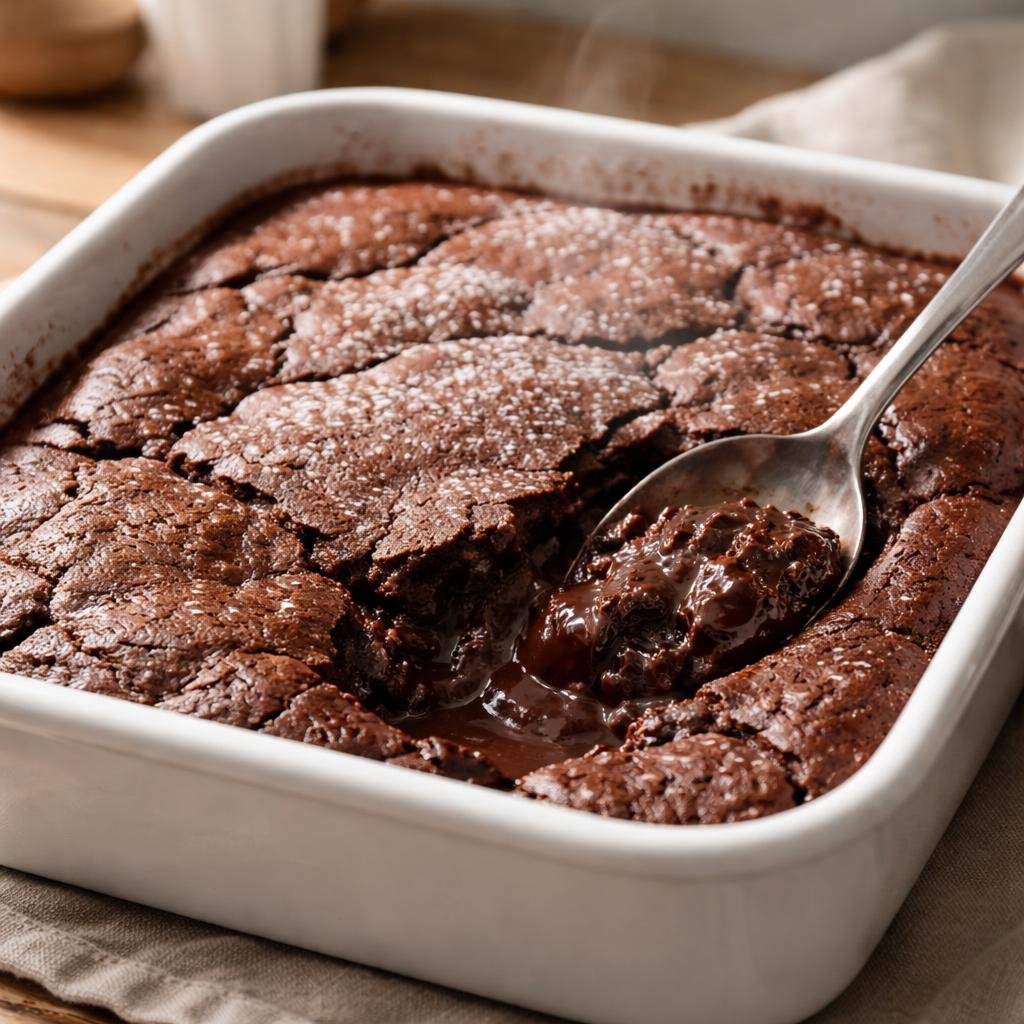
There are Christmas desserts that take all day, a shelf of special equipment, and a long list of ingredients you will only use once, and then there is chocolate brownie pudding, which asks for eight simple ingredients, one baking dish, and fifteen minutes of your time before the oven takes over. Ina Garten Chocolate Brownie Pudding is rich, soft, and full of deep chocolate flavor, and it feels like a mix of brownie and pudding in one dish: the edges set like a brownie while the centre stays soft, warm, and a little gooey. It is the kind of dessert that makes a Christmas table feel generous without keeping the cook in the kitchen, and it is exactly the kind of recipe Ina Garten is known for — simple, elegant, and built on good ingredients handled with care.
A chocolate brownie pudding is one of those desserts that sounds simple and turns out to be quietly clever. Good dark chocolate carries the flavor, fresh butter gives the crumb its richness, and the single most important decision in the whole recipe is when to take it out of the oven. Pull it out while the centre still looks soft and you get the pudding texture that makes this dessert special; leave it in too long and it turns into an ordinary brownie. The recipe takes 15 minutes of prep and 35 minutes in the oven, it serves 6, and the method is simple enough for a first-time baker: melt the butter and chocolate, beat the eggs and sugar until pale and fluffy, fold in the dry ingredients gently, pour into a greased dish, and bake. This guide walks you through the full recipe exactly as it appears on Recipes Walay, with every ingredient, every step, expert tips, variations, serving ideas and answers to the questions people actually ask before they make it.
The full recipe is on Recipes Walay at https://recipeswalay.com/ina-garten-chocolate-brownie-pudding-recipe/
Why You Will Love Ina Garten Chocolate Brownie Pudding
Some recipes earn their place through drama, and some through reliability. This one manages both, which is why it is such a useful dessert to have in your collection. It takes just 15 minutes of hands-on prep, the oven does the rest in 35 minutes, and it serves 6 generously, so it is easy to fit into a busy Christmas schedule. Most of that cooking time is hands-off: put the pudding in the oven, clear the table, and come back to a dessert that smells like a chocolate shop.
The ingredient list is short and honest, with nothing you will only use once: butter, dark chocolate, eggs, sugar, vanilla, flour, salt, and a spoonful of cocoa powder if you want extra richness. Everything on the list is the kind of thing a home baker already keeps in the kitchen, which makes this a dessert you can decide to make on the day itself. That matters at Christmas, when the shops are crowded and the calendar is full.
The texture is what people remember. A regular brownie is firm and cake-like all the way through, but this pudding keeps a soft, almost spoonable centre under a lightly set top. Served warm, straight from the dish, it feels indulgent in a way that a cold slice of cake never quite manages. Children love the gooey middle, adults love the deep chocolate flavor, and nobody needs a knife and fork to enjoy it properly.
It is also a forgiving recipe in the ways that matter and strict in only one way. You can serve it with ice cream, whipped cream, fresh berries, or a drizzle of caramel sauce, and every one of those pairings works. You can add chopped nuts for crunch or dust the top with powdered sugar and it still tastes like itself. The one thing you cannot do is overbake it. That single rule — take it out while the centre is still soft — is the whole secret, and once you know it, the recipe becomes almost impossible to get wrong. It also fits the way Christmas actually works: six servings is right for a family dinner, and the pudding can be prepared a day ahead and reheated gently, so you are never stuck baking while your guests are arriving.
What Is Chocolate Brownie Pudding?
Chocolate brownie pudding sits in the happy middle ground between two desserts everyone already loves. It has the deep chocolate flavor and the familiar comfort of a brownie, but the texture of a warm pudding: soft in the centre, slightly set at the edges, and best eaten warm with a spoon. The recipe comes from Ina Garten, who is known for simple yet elegant dishes, and it shows her approach perfectly — a short ingredient list, a clear method, and one small detail that makes all the difference.
The difference from a regular brownie comes down to baking time and batter. Regular brownies are baked until firm and cake-like all the way through, so they can be cut into neat squares and eaten by hand. This pudding is deliberately taken out of the oven earlier, while the centre is still soft, so it keeps a gooey, spoonable middle. The batter is simple: melted butter and dark chocolate folded into beaten eggs and sugar, with just a quarter cup of flour to hold it together. That small amount of flour is part of the design — it gives the dessert enough structure to set at the edges without turning the centre into cake.
The flavor is deep without being bitter. Dark chocolate gives a richer, more balanced taste than milk chocolate, and the recipe’s own guidance says exactly that: milk chocolate works, but the result is sweeter and less rich. A teaspoon of vanilla rounds out the chocolate, a pinch of salt sharpens it, and the optional spoonful of cocoa powder adds extra depth for anyone who wants it. It is a warm, soft chocolate pudding with brownie roots, served in the dish it baked in, with ice cream melting slowly over the top. There is no unmoulding, no decorating, and no worrying about perfect slices — you bring the dish to the table, hand out spoons, and let people help themselves.
Ingredients You Need for Ina Garten Chocolate Brownie Pudding (with Quantities)
Good baking starts with measuring before you begin, and this recipe rewards that habit. There are only eight ingredients, and each one has a job. Here they are, exactly as listed in the original recipe on Recipes Walay.
Butter comes first: 115g, which is half a cup of unsalted butter. Unsalted matters because the recipe adds its own salt, and starting with unsalted butter keeps the seasoning exactly where the recipe intends it. The butter melts together with the chocolate, and that melted mixture is the base of the whole dessert, so use fresh butter rather than anything that has been sitting open in the fridge picking up other flavors.
Dark chocolate is the star: 115g, which is 4 oz, chopped. Chopping matters because smaller pieces melt faster and more evenly, which keeps the mixture smooth and shiny. The recipe’s own guidance is clear that high-quality dark chocolate is worth it here — it gives a deeper, more balanced flavor than milk chocolate, which would make the pudding sweeter and less rich. If you only have milk chocolate, the recipe says you can use it, but expect a sweeter, lighter result.
Eggs come next: 2 large eggs. They are beaten with the sugar until pale and fluffy, and that step is what gives the pudding its soft, light texture. Large eggs are the standard the recipe is written around. Room-temperature eggs beat up faster and more evenly, so take them out of the fridge while you gather the other ingredients.
Sugar is 1 cup. It sweetens the pudding and, beaten with the eggs, helps create the soft structure. There is no brown sugar, no honey, and no alternative sweetener in the original recipe, and that simplicity is part of why the chocolate flavor comes through so clearly.
Vanilla extract is 1 teaspoon. It is a small amount, but it rounds out the chocolate and stops the dessert from tasting flat. Use real vanilla extract rather than imitation if you have it; in a recipe with so few ingredients, each one carries more weight.
All-purpose flour is a quarter cup. That is deliberately little — far less than a cake or a standard brownie would use — and it is the reason the centre stays soft and pudding-like. Measure it carefully and level it off, because even a little extra flour will push the texture toward cake.
Salt is a quarter teaspoon. It sounds tiny, but it sharpens the chocolate flavor and keeps the sweetness from becoming one-note. Do not skip it, and do not add more than the recipe says.
Cocoa powder is 1 tablespoon, and it is optional, for extra richness. If you love a deep, dark chocolate flavor, add it. If you prefer a lighter, more buttery pudding, leave it out. Either way, the dessert works — the cocoa is a choice, not a requirement. That is the whole list: eight ingredients, one bowl of melted chocolate and butter, one bowl of beaten eggs and sugar, and a gentle fold to bring them together.
Equipment You Need
You do not need a stand mixer, a food processor, or any special baking equipment for this recipe. The original recipe lists seven items, and most kitchens already have all of them.
You need two medium-size mixing bowls. One holds the melted butter and chocolate, the other holds the beaten eggs and sugar, and keeping them separate until the right moment is part of the method. If you only have one bowl, melt the chocolate first, set it aside in a jug, and use the bowl for the eggs — but two bowls make the process smoother.
You need an electric hand mixer or a whisk for beating the eggs and sugar. A hand mixer is faster and gives a paler, fluffier mixture with less effort, but a whisk works perfectly well if you are patient. The mixture should look pale and fluffy before you move on.
You need a spatula for folding the dry ingredients into the wet mixture. A spatula lets you fold gently, which is exactly what the recipe asks for: slow, careful folding keeps the batter soft and smooth, while vigorous stirring would knock the air out and make the pudding dense.
You need measuring cups and spoons. With only eight ingredients and small amounts of flour, salt, and cocoa, accurate measuring matters. Level off the flour and the cocoa, and measure the salt carefully — a heavy hand with salt would show in a dessert this simple.
You need a baking dish, 8 by 8 inches or a similar size. The recipe names that size because it gives the batter the right depth: too large a dish and the pudding bakes thin and dries out; too small and the centre stays raw while the edges overcook. Grease the dish with butter, and if you like, line it with parchment paper — the original recipe suggests both, and either makes serving easier later.
You need an oven, preheated to 180 degrees Celsius, which is 350 degrees Fahrenheit. Preheat it before you start mixing, so the batter goes into a fully hot oven and bakes evenly from the first minute. And you need a cooling rack: the pudding rests for 10 minutes after baking, and a rack lets air move underneath the dish so the base does not go soggy. That is the complete list — nothing exotic, nothing expensive, and nothing you need to buy specially for Christmas.
How to Make Ina Garten Chocolate Brownie Pudding Step by Step
The method has seven steps in the original recipe, and this guide expands them into twelve so that nothing is left to guess. Read through them once before you start, preheat the oven first, and measure everything out — then the whole process takes about fifteen minutes of hands-on time.
Step 1: Preheat the Oven and Prepare Your Workspace
Preheat the oven to 180 degrees Celsius, which is 350 degrees Fahrenheit, before you do anything else. An oven that is still heating when the batter goes in will bake unevenly, and with a dessert that depends on precise timing, that matters. While the oven heats, gather your ingredients and equipment, measure out the butter, chocolate, eggs, sugar, vanilla, flour, salt, and cocoa powder, and chop the dark chocolate into small pieces so it melts quickly and evenly.
Step 2: Melt the Butter and Chocolate
Place the 115g of unsalted butter and the 115g of chopped dark chocolate in a heatproof bowl. Melt them gently, either in the microwave in short bursts or over a double boiler, stirring slowly until the mixture is smooth and shiny. Gentle heat is the key: chocolate that gets too hot can seize and turn grainy, and there is no way back from that. Take the bowl off the heat as soon as the last pieces have melted — the residual heat will finish the job.
Step 3: Let the Chocolate Mixture Cool Slightly
Set the melted butter and chocolate aside for a few minutes to cool slightly before you use it. This step is easy to skip and important not to. If the chocolate mixture is still hot when it meets the beaten eggs, it can cook the eggs and turn the batter lumpy. A few minutes on the counter is enough — the mixture should feel warm rather than hot when you touch the outside of the bowl. Use this time to grease your baking dish.
Step 4: Beat the Eggs and Sugar
In another bowl, add the 2 large eggs and the 1 cup of sugar. Beat well using a hand mixer or a whisk until the mixture looks pale and fluffy. This step helps create the soft texture that defines the dessert, so do not rush it. With a hand mixer it takes a couple of minutes; with a whisk it takes a little longer, but the result is the same. You are looking for a mixture that has visibly lightened in color and thickened slightly.
Step 5: Add the Vanilla and the Chocolate Mixture
Pour the melted chocolate mixture into the egg mixture, add the 1 teaspoon of vanilla extract, and mix gently until everything combines smoothly. Pour slowly and stir as you go, so the two mixtures come together evenly. Do not overmix at this stage — you are combining, not beating. A few gentle strokes with the spatula is enough. The batter should look uniform, dark, and glossy.
Step 6: Fold in the Dry Ingredients
Now add the quarter cup of all-purpose flour, the quarter teaspoon of salt, and the tablespoon of cocoa powder, if you are using it. Fold the mixture slowly using a spatula, scraping from the bottom of the bowl and turning the batter over on itself. Keep the batter soft and smooth, and avoid mixing too hard. Overmixing would develop the flour and make the pudding tough. Stop as soon as you cannot see any dry flour.
Step 7: Grease the Baking Dish
Grease your baking dish with butter. The recipe calls for an 8 by 8 inch dish or a similar size, and you can also line it with parchment paper. This helps prevent sticking and makes serving easier later, especially since this is a dessert you serve warm and soft, straight from the dish. Get the butter into the corners and up the sides, because the pudding will cling to any dry spot.
Step 8: Pour the Batter into the Dish
Pour the batter into the prepared dish and spread it evenly with the spatula. Take a few seconds to push the batter gently into the corners and level the top, because an uneven layer will bake unevenly — thin spots will overcook while thick spots stay raw. Do not bang the dish on the counter; a gentle spread is all it needs.
Step 9: Bake for About 35 Minutes
Bake in the preheated oven at 180 degrees Celsius, or 350 degrees Fahrenheit, for about 35 minutes. Set a timer, and resist the urge to open the oven door to check on it in the first twenty minutes — every time the door opens, the temperature drops and the baking time stretches. The pudding will rise slightly and the top will set while the centre stays soft. Ovens vary, so the recipe’s 35 minutes is a guide rather than a rule, and the real test is in the next step.
Step 10: Check the Centre — Edges Set, Middle Soft
This is the step that makes the dessert. The centre should stay slightly soft when the pudding comes out of the oven. The edges should look set and the top should look dry, but the middle should still wobble very slightly when you gently shake the dish. If the centre looks fully firm and dry, it has gone too far and will taste like an ordinary brownie. If it still looks wet and liquid, give it a few more minutes. Trust the wobble: the pudding continues cooking slightly from its own residual heat after you take it out.
Step 11: Cool for 10 Minutes
Let the pudding cool for 10 minutes before serving. Place the dish on the cooling rack so air can move underneath it. During this rest, the pudding will firm up slightly but stay gooey inside, and the flavors will settle. Ten minutes is enough — much longer and it will cool too much and lose the warm, melting quality that makes it special. Use the time to scoop the ice cream or wash the berries.
Step 12: Serve Warm
Serve warm for the best taste. Spoon the pudding straight from the dish into bowls or onto plates, and add your chosen topping while it is still warm enough for ice cream to melt slowly over the top. The contrast of warm, gooey chocolate against cold vanilla ice cream is the pairing the original recipe calls its perfect match. Serve immediately, while the centre is still soft.
Expert Tips for Perfect Chocolate Brownie Pudding
The original recipe gives five tips, and each one is worth following exactly. They are short, practical, and they cover the things that actually go wrong with this dessert.
Use high-quality dark chocolate for deeper flavor. This is the first tip the recipe gives, and it is the one that makes the biggest difference. With only eight ingredients, the chocolate carries most of the flavor, so a good bar of dark chocolate will show in every bite. You do not need the most expensive chocolate in the shop, but do choose one you would enjoy eating on its own.
Do not overbake, or it will lose its pudding texture. This is the second tip, and it is the whole secret of the recipe. The dessert should stay soft and a little gooey in the centre — that is what makes it special. Set a timer, check at 35 minutes, and take it out while the centre still looks soft. Remember that it keeps cooking after it leaves the oven, so what looks slightly underdone is usually exactly right.
Add chopped nuts for extra crunch. If you like texture in your chocolate desserts, a handful of chopped nuts folded into the batter or scattered over the top adds a welcome contrast to the soft centre. Walnuts and pecans both work well, and the nuts toast gently in the oven as the pudding bakes.
Serve with vanilla ice cream for a perfect pairing. Warm chocolate pudding and cold vanilla ice cream is one of the great dessert combinations, and the original recipe names it directly. The ice cream melts slowly into the warm pudding, the vanilla softens the richness of the chocolate, and the temperature contrast makes each spoonful more interesting.
Sprinkle powdered sugar on top for a nice finish. A light dusting of powdered sugar just before serving makes the pudding look finished and festive, which matters at Christmas. Use a small sieve or a tea strainer, hold it high above the dish, and tap gently so the sugar falls in a fine, even snow. Do it at the last moment, because the sugar will melt into the warm surface if it sits too long.
Beyond those five tips, two habits will serve you well. First, mix gently — the original recipe says it plainly: do not rush the batter. When you take your time and fold slowly, the texture becomes smooth and perfect. Second, measure carefully. A quarter cup of flour and a quarter teaspoon of salt are small amounts, and small errors show up quickly in a recipe this simple.
Variations to Try
The base recipe is complete on its own, but it also takes well to small changes, and every variation below is built from ideas the original recipe itself suggests. None of them change the method — they change one ingredient or one topping, and the baking time stays the same.
The nutty version is the simplest change. The original recipe’s own tip is to add chopped nuts for extra crunch, so fold a small handful of chopped walnuts or pecans into the batter before you pour it into the dish, or scatter them over the top before baking. The nuts toast as the pudding bakes and give each spoonful a little crunch against the soft centre.
The milk chocolate version is for anyone who prefers a sweeter, lighter chocolate flavor. The original recipe’s own FAQ says you can use milk chocolate instead of dark chocolate, and it is honest about the trade-off: the flavor will be sweeter and less rich, and dark chocolate gives a deeper and more balanced taste. Swap the 115g of dark chocolate for the same weight of milk chocolate and change nothing else.
The extra-rich version uses the optional cocoa powder. The ingredient list offers 1 tablespoon of cocoa powder, optional, for extra richness, and adding it deepens the chocolate color and flavor without changing the texture. If you are a serious chocolate lover, this is the version to make. Fold it in with the flour and salt, and expect a darker, more intense pudding.
The berries version changes the topping rather than the pudding. The original recipe lists fresh strawberries or raspberries among its serving suggestions, and a handful of berries on top of each warm serving adds freshness, color, and a tart edge that cuts through the richness. At Christmas, raspberries look especially festive against the dark chocolate.
The caramel version uses another serving suggestion from the original recipe: a caramel sauce drizzle. A thin ribbon of caramel over each warm portion adds sweetness and a buttery note that pairs beautifully with dark chocolate. Keep the drizzle light — the pudding is already rich, and the caramel should be an accent.
The coffee version is a pairing rather than a change to the recipe, but it changes the experience enough to mention. The original recipe suggests hot coffee or cappuccino alongside the pudding, and serving the dessert with coffee turns it into a proper after-dinner course. The bitterness of the coffee balances the sweetness of the pudding. Whatever variation you choose, keep the core rule the same: do not overbake.
What to Serve with Chocolate Brownie Pudding
The original recipe gives five serving suggestions, and they cover every mood a dessert can be in — cold, fresh, warm, light, and indulgent. Choose one, or set out two or three and let people help themselves.
Vanilla ice cream is the first suggestion and the one the recipe calls a perfect pairing. A scoop of good vanilla ice cream on warm pudding is a classic for a reason: the cold cream melts slowly into the chocolate, the vanilla softens the richness, and the contrast of temperatures makes the dessert feel more generous than it is.
Fresh strawberries or raspberries are the fresh option. Their tartness cuts through the richness of the chocolate, their color makes the plate look festive, and they need no cooking or preparation. Raspberries are especially good at Christmas, when their deep red color suits the season, and a small handful per serving is enough.
Hot coffee or cappuccino is the grown-up pairing. The original recipe lists it among its serving suggestions, and it works because the slight bitterness of coffee balances the sweetness of the pudding. Serve the pudding as the final course of a dinner party, with coffee alongside, and it feels like a restaurant dessert rather than a home bake.
Whipped cream is the light option. A cloud of softly whipped cream on top of warm pudding adds richness without weight, and it looks beautiful — especially with a dusting of powdered sugar over the top. Whip the cream just before serving so it holds its shape, and do not sweeten it heavily, because the pudding is sweet enough on its own.
A caramel sauce drizzle is the indulgent option. The original recipe lists it as a serving suggestion, and a thin ribbon of caramel over each portion adds a buttery sweetness that pairs naturally with dark chocolate. Use a good-quality sauce and keep the drizzle thin.
Beyond the five suggestions, the pudding sits happily alongside other desserts on a Christmas table. If you are building a dessert spread, it works next to a lighter bake — for example, the bright citrus of an easy lemon loaf cake — because the contrast keeps the table interesting. Our guide to Ina Garten lemon loaf cake for Christmas is at https://recipeswalay.com/easy-ina-garten-lemon-loaf-cake-for-christmas/ and our guide to Ina Garten lemon meringue pie for Christmas is at https://recipeswalay.com/easy-ina-garten-lemon-meringue-pie-for-christmas/ — both are lighter, fruit-led desserts that balance a rich chocolate pudding beautifully.
Make-Ahead and Storage
One of the best things about this pudding is that it does not demand to be baked at the last minute. The original recipe answers the make-ahead question directly: yes, you can prepare it a day before, store it in the fridge, and reheat gently before serving, and it still tastes amazing when warm.
For leftovers, the rules are simple and come straight from the original recipe. Store the pudding in an airtight container in the fridge for up to 3 days. An airtight container matters because the pudding will pick up other flavors from the fridge if it is left uncovered, and it will also dry out. Let it cool completely before you put the lid on, so condensation does not make the surface soggy.
To reheat, use the microwave for 20 to 30 seconds before serving. That is enough to bring back the warm, gooey texture without overcooking it. The recipe warns not to overheat, or the pudding may dry out — and it means it. A few seconds too long in the microwave will turn a soft pudding into a dry brownie, so heat it in short bursts and check after each one.
You can also freeze the pudding for up to 1 month. Wrap it well, label it with the date, and thaw it in the fridge overnight before reheating. Thawing slowly in the fridge keeps the texture even, and the same gentle microwave reheat brings it back to serving temperature. If you are planning ahead for Christmas, this means you can bake the pudding well before the day itself.
A practical note for the day itself: if you are baking the pudding fresh, remember that it needs 10 minutes of cooling before serving and is best served warm. Time it so that it comes out of the oven just as the main course is finishing. For more make-ahead Christmas dessert ideas, see our roundup of easy Christmas brownie recipes for a sweet holiday season at https://recipeswalay.com/easy-christmas-brownie-recipes-for-a-sweet-holiday-season/ and our guide to easy Christmas eve desserts for a sweet holiday night at https://recipeswalay.com/easy-christmas-eve-dessert-recipes-for-a-sweet-holiday-night/
Nutrition and Calories
The original recipe gives a clear nutrition panel for one serving, and this guide reports it exactly as published, with one honest gap noted below. One serving of Ina Garten Chocolate Brownie Pudding contains 420 kcal. Carbohydrates are 45g, protein is 6g, fat is 24g, and sugar is 32g. Those figures are per serving, and the recipe serves 6.
The numbers tell a fair story about what this dessert is. It is a rich, celebratory pudding, and 420 kcal per serving is in line with a proper chocolate dessert made with butter, dark chocolate, and sugar. The fat figure of 24g reflects the butter and the chocolate, and the sugar figure of 32g reflects the cup of sugar spread across six servings. The protein figure of 6g comes mostly from the eggs, and the carbohydrate figure of 45g covers the sugar and the small amount of flour.
One thing to state plainly: the original recipe gives no fiber figure and no sodium figure for this dessert, so this guide does not invent them. If you are tracking fiber or sodium closely, the numbers above are the complete set the recipe publishes. The quarter teaspoon of salt in the whole dish is a small amount spread across six servings, but without a published figure, this guide will not guess at one.
For context, the richness is the point. This is not an everyday dessert, and it is not trying to be one. It is a Christmas pudding in the truest sense: something special, served warm, shared with people you like, in a sensible portion. If you want lighter Christmas desserts alongside it, our roundup of easy winter chocolate recipes for cozy holiday desserts is at https://recipeswalay.com/easy-winter-chocolate-recipes-for-cozy-holiday-desserts/ and our winter dessert roundup is at https://recipeswalay.com/easy-winter-dessert-recipes/
Occasions to Serve Chocolate Brownie Pudding
The original recipe names five occasions, and they cover most of the year — but this dessert truly shines at Christmas, when a warm chocolate pudding feels like exactly the right ending to a long, rich meal.
Family dinners are the first occasion, and the most natural one. Six servings is a family-sized recipe, the method is simple enough to make on a weeknight, and the pudding is the kind of dessert that gets children and grandparents agreeing for once. Serve it straight from the dish and let people add their own ice cream.
Weekend treats are the second occasion. A Saturday or Sunday evening, a quiet house, a warm pudding in the oven — it is a small luxury that costs very little effort. Bake it on a weekend in December and the whole house will smell like a chocolate shop.
Birthday celebrations are the third occasion. Not every birthday needs a layered cake, and a warm chocolate pudding with ice cream can feel more special than a cake that took all day. It is also easier to serve: no slicing, no crumbs, no worry about whether the layers will hold.
Dinner parties are the fourth occasion, and this is where the pudding earns its reputation as an Ina Garten recipe. It looks elegant served in bowls with a dusting of powdered sugar and a few raspberries, it can be made a day ahead and reheated, and it lets the host sit down with their guests instead of fussing in the kitchen. Serve it with coffee and it feels like a restaurant course.
Romantic evenings are the fifth occasion. Two servings from a six-serving dish, a quiet table, and a shared pudding with two spoons — the recipe’s own suggestion, and a good one. The leftovers keep for three days in the fridge, so nothing is wasted. For Christmas itself, the pudding fits anywhere in the holiday: as the dessert after Christmas dinner, as a Boxing Day treat, or as the sweet ending to a Christmas Eve gathering. Our roundup of easy Christmas desserts for the holidays is at https://recipeswalay.com/easy-christmas-desserts-for-the-holidays/ and our guide to easy Christmas pie recipes is at https://recipeswalay.com/easy-christmas-pie-recipes/
FAQs about Ina Garten Chocolate Brownie Pudding
How do I make Ina Garten Chocolate Brownie Pudding perfectly gooey?
To keep it gooey, do not overbake the pudding. Remove it from the oven when the edges are set but the centre still looks soft — it will continue cooking slightly from its own residual heat after you take it out. The original recipe gives this as its first FAQ and its most important tip. Set a timer for 35 minutes, check the centre with a gentle shake of the dish, and trust the wobble.
Can I use milk chocolate instead of dark chocolate?
Yes, you can use milk chocolate. However, the flavor will be sweeter and less rich. Dark chocolate gives a deeper and more balanced taste, which is why the original recipe calls for it. If you make the swap, use the same weight — 115g, or 4 oz — and change nothing else. This is a good version for children or for anyone who finds dark chocolate too intense.
What makes this different from regular brownies?
This dessert has a softer, pudding-like centre. Regular brownies are firmer and more cake-like all the way through, so they can be cut into neat squares. This recipe is deliberately baked for a shorter time and uses only a quarter cup of flour, so the centre stays soft and spoonable while the edges set. It is served warm from the dish with a spoon, rather than cut into squares.
Can I make this recipe ahead of time?
Yes, you can prepare it a day before. Store it in the fridge and reheat gently before serving — the microwave for 20 to 30 seconds is enough — and it still tastes amazing when warm. You can also freeze it for up to 1 month, thaw it in the fridge overnight, and reheat it the same way. The original recipe answers this question directly, and it is one of the reasons the pudding is so useful at Christmas.
What are the best toppings for this dessert?
Vanilla ice cream, whipped cream, or fresh berries work best. These toppings balance the rich chocolate flavor beautifully, according to the original recipe. Vanilla ice cream is the classic pairing — cold against warm, vanilla against chocolate — while whipped cream adds lightness and fresh strawberries or raspberries add a tart, fresh edge. A caramel sauce drizzle is another option the recipe suggests, and a dusting of powdered sugar makes the finished dish look festive.
How do I know when the brownie pudding is done?
Look for edges that are set and a top that looks dry, with a centre that still looks soft and wobbles very slightly when you gently shake the dish. That is the moment to take it out. The original recipe says the centre should stay slightly soft after about 35 minutes at 180 degrees Celsius, and it will continue cooking slightly after removal. If the centre looks wet and liquid, give it a few more minutes; if it looks fully firm and dry, it has gone too far.
Final Thoughts
Ina Garten Chocolate Brownie Pudding is simple, rich, and full of comfort. It brings warmth to any table, and once you learn how to make it, you will want to make it again and again. The ingredients are basic, but the result feels special — and that is exactly what a good Christmas dessert should be.
It is a recipe that respects the cook. Fifteen minutes of prep, one baking dish, eight ingredients, and a single rule to remember: do not overbake. Everything else — the ice cream, the berries, the powdered sugar, the coffee alongside — is a pleasure rather than a chore. Make it for your family dinner, make it a day ahead and reheat it gently, or freeze it and save it for the moment you need it. However you serve it, serve it warm, with a spoon, and with people you like around the table.
If this pudding has earned a place in your Christmas plans, you will find more holiday baking in our guides. Start the day with our guide to Ina Garten breakfast strata for Christmas at https://recipeswalay.com/easy-ina-garten-breakfast-strata-for-christmas/ and finish the season with more chocolate in our winter chocolate roundup. The full original recipe, with its printable card, is on Recipes Walay at https://recipeswalay.com/ina-garten-chocolate-brownie-pudding-recipe/