

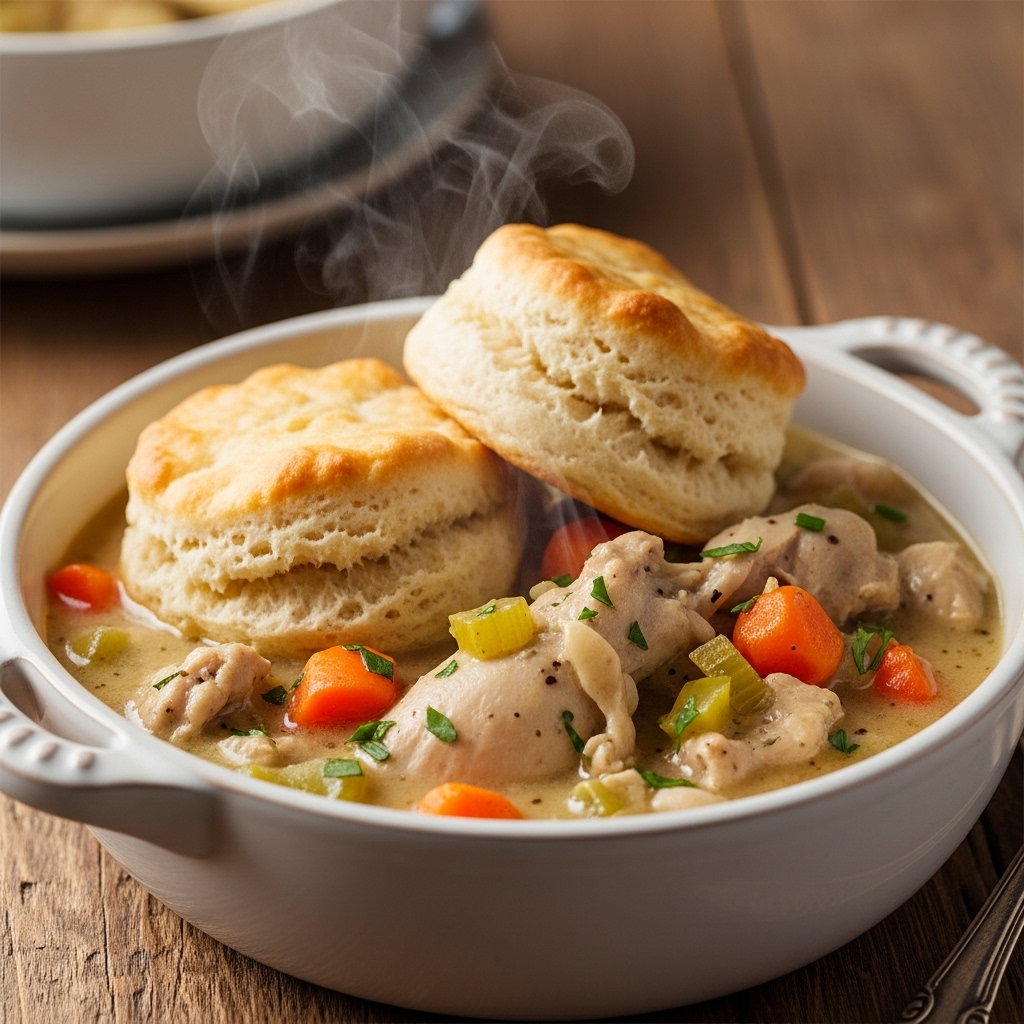
Comfort food feels best on quiet winter evenings, bringing calm and steady joy to the table, and few dishes deliver that feeling as completely as chicken stew and biscuits. Ina Garten Chicken Stew and Biscuits is rich yet beautifully balanced, with familiar and deeply satisfying flavors: the chicken stays tender through gentle simmering, the vegetables add color, texture, and natural sweetness, and biscuits bake golden and soft on top, soaking up the flavorful broth while staying fluffy and light. It suits family dinners and relaxed weekends, and every bite feels nourishing and thoughtfully prepared.
This is a dish built on classic methods and honest ingredients that never feel rushed or overly complex. Flavors develop slowly with steady heat, creating depth without stress, and the recipe rewards patience along with quality ingredients. It takes 20 minutes of prep and 1 hour of cooking, it serves 6, and it works well for all skill levels. The stew simmers gently in one pot, the biscuit dough comes together in a separate bowl, and the two meet in the oven for a golden finish. This guide walks you through the full recipe exactly as it appears on Recipes Walay, with every ingredient, every step, expert tips, variations, serving ideas and answers to the questions people actually ask before they make it.
The full recipe is on Recipes Walay at https://recipeswalay.com/ina-garten-chicken-stew-and-biscuits-recipe/
Why You Will Love Ina Garten Chicken Stew and Biscuits
Some recipes earn their place through drama, and some through reliability. This one manages both in its own way, which is why it is such a useful dish to have in your winter collection. It takes just 20 minutes of hands-on prep, the pot does most of the work over the next hour, and it serves 6 generously, so it is easy to fit into a family dinner or a relaxed weekend. Most of the cooking time is a gentle simmer that asks nothing of you except an occasional check.
The ingredient list is short and honest. There are no unusual items to hunt for: bone-in chicken thighs, olive oil, onion, carrots, celery, garlic, flour, chicken stock, milk, thyme, salt, and pepper for the stew, and flour, baking powder, salt, cold butter, and cold milk for the biscuits. Everything on the list is the kind of thing a home cook already keeps in the kitchen, which makes this a dinner you can decide to make on the day itself rather than planning a special shopping trip around it.
The texture is what people remember. The chicken cooks gently until it is juicy and tender, the vegetables soften into the broth without falling apart, and the biscuits bake golden on top — fluffy inside, lightly crisp outside, and soaked just enough underneath with the flavorful broth. It is a complete meal in one pot, with the bread built right in, and that is part of its charm.
It is also a recipe that rewards the cook’s patience rather than their speed. The flavors develop slowly with steady heat, the herbs add aroma without overpowering the dish, and the whole thing feels dependable: a recipe you can make once, trust completely, and come back to all winter. Home cooks trust recipes built with simple structure and clear steps, and this one delivers warmth without heavy effort.
Finally, it fits the way winter dinners actually work. Six servings is right for a family table, the stew is hearty enough to be the whole meal, and the biscuits mean there is nothing else you have to bake. It is the kind of dinner that makes a cold evening feel like a good decision.
What Is Chicken Stew and Biscuits?
Chicken stew and biscuits is a classic American comfort dish: a rich, savory stew of chicken and vegetables, topped with soft biscuits that bake right on the surface of the pot. The biscuits soak up the flavorful broth from underneath while their tops turn golden and crisp in the oven, so each serving gives you tender chicken, sweet vegetables, and warm, fluffy bread in a single spoonful. The recipe comes from Ina Garten, and it reflects her approach perfectly — balance and clarity, simple structure, and flavors that develop slowly.
The dish works because it balances comfort with quiet elegance. The chicken cooks gently for a juicy texture, while herbs add aroma without overpowering the dish. The stew itself is a straightforward build: brown the chicken, soften the vegetables, thicken with flour, add stock and milk, and simmer covered until everything is tender. The biscuits are equally simple — flour, baking powder, salt, cold butter, and cold milk — mixed just enough to come together and no more.
The flavor is warm and familiar. Bone-in chicken thighs give the stew a deeper flavor than boneless cuts would, the onion, carrots, and celery build the classic savory base, garlic adds warmth, and a single teaspoon of fresh thyme gives the whole pot a gentle herbal note. The milk softens the broth and rounds out the flavors, so the stew tastes rich without feeling heavy. Nothing in the dish shouts; everything works together quietly, which is why it feels elegant rather than showy.
It is also a dish with a clear identity on the table. It is not a soup, though it shares the same roots — the stew is thicker, heartier, and built to be a main course, with the biscuits making it complete. It is not a pot pie either, though it is a close cousin: where a pot pie hides its filling under a pastry lid, this stew wears its biscuits proudly on top, golden and visible. Serve it in deep bowls, straight from the pot, and let people break off pieces of biscuit and dip them into the broth. That informality is part of its charm.
For winter, it is hard to beat. The dish suits gatherings as well as quiet family meals, it warms the kitchen while it cooks, and it turns an ordinary evening into something worth sitting down for. It is the kind of recipe that earns a regular place in the rotation.
Ingredients You Need for Ina Garten Chicken Stew and Biscuits (with Quantities)
Good cooking starts with measuring before you begin, and this recipe rewards that habit. There are seventeen ingredients in total — twelve for the stew and five for the biscuits — and each one has a job. Here they are, exactly as listed in the original recipe on Recipes Walay.
For the chicken stew, start with 2 pounds of bone-in chicken thighs. Bone-in matters: the original recipe’s own tip says to use bone-in chicken for deeper flavor, and the bones add richness to the broth as the stew simmers. Thighs are the right cut here because they stay juicy through a long, gentle simmer, where leaner cuts would dry out.
Olive oil is 2 tablespoons, for browning the chicken and softening the vegetables. It is the cooking fat for the whole dish, so use a good olive oil, but there is no need for anything fancy — a regular cooking olive oil is exactly right.
The vegetables are 1 large onion, chopped; 3 carrots, sliced; and 3 celery stalks, sliced. Together they form the classic savory base of the stew, adding sweetness, color, and texture. Cut them evenly — the original recipe’s tip says to cut vegetables evenly for uniform cooking — so that everything softens at the same rate and no piece is raw while another is falling apart.
Garlic is 3 cloves, minced. It goes in after the vegetables have softened, and it only needs a brief stir before the flour goes in. Mince it finely so it melts into the stew rather than sitting in visible pieces.
All-purpose flour is 3 tablespoons for the stew. It is sprinkled over the vegetables and stirred until smooth, and it is what thickens the broth into a proper stew rather than a soup. Stir it well so no dry pockets remain.
Chicken stock is 4 cups, poured in slowly while stirring. Pouring slowly matters: it lets the flour dissolve evenly into the liquid instead of clumping. Use a good stock, because it carries much of the stew’s flavor.
Milk is 1 cup for the stew. It softens the broth, rounds out the flavors, and gives the stew its gentle richness. Add it with the stock, thyme, salt, and pepper, before the chicken goes back into the pot.
Fresh thyme is 1 teaspoon. It is the only herb in the recipe, and it gives the stew its quiet, aromatic note. Fresh thyme is worth using here rather than dried, because the flavor is gentler and cleaner.
Salt is 1 teaspoon for the stew, and black pepper is half a teaspoon. Season carefully: the stock already carries salt, and the biscuits have their own salt, so the recipe’s measures keep the whole dish balanced.
For the biscuits, you need 2 cups of all-purpose flour, 1 tablespoon of baking powder, 1 teaspoon of salt, 6 tablespoons of cold butter, and three quarters of a cup of cold milk. The cold butter and cold milk are the key to fluffy biscuits — the original recipe’s tip says to use cold butter for fluffy biscuits, and cold milk keeps the dough cool while you work. The baking powder is what lifts the biscuits as they bake, and the salt seasons them.
That is the whole list. Seventeen ingredients, one pot, one bowl of biscuit dough, and a gentle simmer to bring them together. When a recipe is this straightforward, quality matters more than quantity: good chicken, a good stock, and cold butter are the choices that make the biggest difference.
Equipment You Need
You do not need any special equipment for this recipe. The original recipe lists nine items, and most kitchens already have all of them.
You need a large heavy-bottomed pot. Heavy-bottomed matters because the stew simmers gently for a long time, and a thin pot can scorch the flour-thickened broth on the bottom. The pot also needs to be oven-safe, because the biscuits bake on top of the stew in the same pot — so check that the handles and lid can take the heat of the oven before you begin.
You need a wooden spoon for stirring. A wooden spoon is gentle on the pot, it does not conduct heat, and it is the right tool for stirring the flour into the vegetables and for scraping the bottom of the pot as the stock goes in.
You need a sharp knife and a cutting board for the onion, carrots, celery, and garlic. A sharp knife matters more than it might seem: clean cuts mean even pieces, and even pieces mean uniform cooking, which is exactly what the recipe’s tip asks for.
You need measuring cups and measuring spoons. With 4 cups of stock, 1 cup of milk, and small amounts of flour, thyme, salt, and pepper, accurate measuring keeps the stew balanced. Level off the flour and the baking powder, and measure the salt carefully.
You need a baking sheet. It goes under the pot in the oven, or beside it, to catch any drips as the stew bubbles and the biscuits bake. It also gives you somewhere to rest the hot pot when it comes out of the oven.
You need a pastry cutter for the biscuit dough. A pastry cutter works the cold butter into the flour quickly and evenly, which is what makes the biscuits fluffy. If you do not have one, two knives or your fingertips will do — but work fast, because warm hands will melt the butter, and cold butter is the whole point.
You need a mixing bowl for the biscuit dough. Keep the dough work separate from the pot, and keep it cool: cold butter and cold milk go into the bowl, and the dough should be handled as little as possible.
That is the complete list. One pot, a wooden spoon, a knife and board, measuring cups and spoons, a baking sheet, a pastry cutter, and a mixing bowl. Nothing exotic, nothing expensive, and nothing you need to buy specially for winter.
How to Make Ina Garten Chicken Stew and Biscuits Step by Step
The method is a compact twelve-line list in the original recipe, and this guide expands it into twelve steps so that nothing is left to guess. Read through them once before you start, and measure everything out — then the whole process takes about twenty minutes of hands-on time, with the pot doing the rest.
Step 1: Gather and Measure Everything
Measure out all seventeen ingredients before you turn on the heat. Chop the onion, slice the carrots and celery, mince the garlic, and have the flour, stock, milk, thyme, salt, and pepper within reach. Measure the biscuit ingredients too — flour, baking powder, salt, cold butter, and cold milk — and keep the butter and milk in the fridge until you need them, so they stay cold. A calm, prepared start is the difference between a relaxed cook and a rushed one, and it matters most with a stew, where each step follows quickly on the last.
Step 2: Heat the Oil in the Pot
Heat the 2 tablespoons of olive oil in the large heavy-bottomed pot, gently, over medium heat. Gentle heat is the right start: the oil should shimmer and flow easily, but it should not smoke. If the oil smokes, it is too hot, and the chicken will burn on the outside before it browns properly. Give the pot a moment to heat evenly, and swirl the oil so it coats the bottom.
Step 3: Brown the Chicken on Both Sides
Add the 2 pounds of bone-in chicken thighs to the pot and brown them on both sides evenly. Do not crowd the pot — if the thighs are packed in tightly, they will steam instead of browning, and you will lose the deep flavor that browning builds. Work in batches if you need to. Let each side sit undisturbed until it has a good golden color before you turn it; moving the chicken too often stops the browning. The chicken does not need to be cooked through at this stage — it will finish in the simmer — but the browned surface is where much of the stew’s flavor comes from.
Step 4: Remove the Chicken and Set It Aside
Remove the browned chicken from the pot and set it aside on a plate. Leave the browned bits and the oil in the pot — that is flavor, and it will dissolve into the stew as the vegetables cook. Cover the chicken loosely to keep it warm, and do not worry if it cools slightly; it is going back into the pot to simmer. This pause also gives you a clean pot to build the vegetable base in, which is the next step.
Step 5: Saute the Onion, Carrot, and Celery Softly
Add the chopped onion, sliced carrots, and sliced celery to the pot and saute them softly in the remaining oil. Cook them gently, stirring with the wooden spoon, until the onion turns translucent and the vegetables begin to soften. This is not a race: softening the vegetables slowly builds sweetness into the stew, and rushing them on high heat will brown them before they soften. Take your time, and let the vegetables release their flavor into the oil.
Step 6: Add the Garlic and Stir Briefly
Add the 3 cloves of minced garlic and stir briefly. Garlic cooks fast and burns easily, so this step is short by design — a brief stir, just until the garlic smells fragrant, is enough. If the garlic starts to color, move on to the next step immediately. The garlic should melt into the vegetables, not stand out as a separate flavor.
Step 7: Sprinkle in the Flour and Stir Until Smooth
Sprinkle the 3 tablespoons of all-purpose flour over the vegetables and stir until smooth. This is the step that thickens the stew, so stir well and take a moment to work the flour into the oil and vegetables until no dry pockets remain. The mixture will look thick and pasty, and that is exactly right. Let it cook for a short moment, stirring, so the flour loses its raw taste before the liquid goes in.
Step 8: Pour in the Stock Slowly While Stirring
Pour the 4 cups of chicken stock slowly while stirring. Pouring slowly matters: it lets the flour dissolve evenly into the liquid instead of clumping into lumps that no amount of stirring will fix. Keep stirring as you pour, and scrape the bottom of the pot with the wooden spoon as you go — the browned bits left from the chicken will dissolve into the stock and deepen the flavor of the whole stew.
Step 9: Add the Milk, Thyme, Salt, and Pepper
Add the 1 cup of milk, the 1 teaspoon of fresh thyme, the 1 teaspoon of salt, and the half teaspoon of black pepper. Stir gently to combine. The milk softens the broth and rounds out the flavors, and the thyme gives the stew its quiet herbal note. Taste the broth at this point if you like, and remember that the chicken will add more flavor as it simmers — the seasoning should taste just right, not strong, because the stew will concentrate slightly as it cooks.
Step 10: Return the Chicken and Simmer Covered
Return the chicken to the pot and simmer covered. Nestle the thighs into the broth so they are mostly covered, put the lid on, and keep the heat low — the original recipe’s tip says to keep the heat low for tender meat, and it means it. A gentle simmer, with small bubbles breaking the surface, is what you want; a hard boil will toughen the chicken. The recipe’s total cooking time is 1 hour, and the chicken should cook gently until it is tender all the way through. The original recipe does not give a separate simmer time, so judge by tenderness: the meat should yield easily and pull cleanly from the bone.
Step 11: Prepare the Biscuit Dough and Cut the Biscuits
While the stew simmers, prepare the biscuit dough separately. In the mixing bowl, combine the 2 cups of all-purpose flour, the 1 tablespoon of baking powder, and the 1 teaspoon of salt. Cut in the 6 tablespoons of cold butter with the pastry cutter until the mixture looks like coarse crumbs, then stir in the three quarters of a cup of cold milk just until the dough comes together. Do not overmix the biscuit dough — the original recipe’s tip is clear about this, and overmixing is what makes biscuits tough instead of fluffy. Turn the dough out, pat it gently, and cut the biscuits. Keep the butter cold and the handling light, and the biscuits will bake up fluffy.
Step 12: Place the Biscuits on the Stew and Bake Until Golden
Cut the biscuits and place them on top of the stew, then bake until the biscuits turn golden. Arrange them in a single layer with a little space between them so the heat can move around each one. One honest note here: the original recipe does not give an oven temperature for this step, so this guide does not invent one — bake until the biscuits turn golden, as the recipe directs, with the tops crisp and the insides fluffy. Serve the stew straight from the pot, in deep bowls, with a biscuit on top of each serving and the broth spooned over.
Expert Tips for Perfect Chicken Stew and Biscuits
The original recipe gives five tips, and each one is worth following exactly. They are short, practical, and they cover the things that actually go wrong with this dish.
Use bone-in chicken for deeper flavor. This is the first tip the recipe gives, and it is the one that makes the biggest difference to the stew. Bone-in thighs give the broth a richness that boneless cuts cannot match, and the meat stays juicy through a long, gentle simmer. If you are tempted to swap in boneless chicken to save time, know that you will be trading away flavor — the bones are doing real work here.
Keep the heat low for tender meat. This is the second tip, and it is the whole secret of the simmer. A gentle simmer, with small bubbles breaking the surface, keeps the chicken tender; a hard boil will toughen it. Once the chicken goes back into the pot, turn the heat down, put the lid on, and let time do the work. Patience here is worth more than any ingredient.
Cut the vegetables evenly for uniform cooking. This is the third tip, and it is about the knife work you do at the start. Even pieces soften at the same rate, so no piece is raw while another is falling apart. Take the extra minute to cut the onion, carrots, and celery into similar sizes — it shows in the finished stew, where every spoonful has the same balance of vegetables.
Use cold butter for fluffy biscuits. This is the fourth tip, and it is the key to the biscuit topping. Cold butter stays in small pieces in the dough, and those pieces melt in the oven to create steam, which is what lifts the biscuits and makes them fluffy. Warm butter melts into the flour before baking and gives you flat, dense biscuits instead. Keep the butter in the fridge until the moment you need it, and work fast once it is in the dough.
Do not overmix the biscuit dough. This is the fifth tip, and it is the one most likely to be ignored. Mix the dough just until it comes together and no more — a few dry flecks are better than a smooth, overworked dough. Overmixing develops the flour and makes the biscuits tough, which is the opposite of what you want. Gentle hands make fluffy biscuits.
Beyond those five tips, one habit will serve you well: read the whole recipe before you start. The stew and the biscuits come together in sequence, and knowing what comes next means you can prepare the biscuit dough while the stew simmers instead of scrambling at the last minute. The recipe is simple, but it rewards a cook who is prepared.
Variations to Try
The base recipe is complete on its own, but it takes well to small changes, and every variation below is built from ideas the original recipe itself suggests. None of them change the core method — they change the emphasis, the serving style, or the finish, and the stew itself stays the same.
The classic way is to bake the biscuits on top of the stew exactly as written. The biscuits soak up the flavorful broth from underneath while their tops turn golden and crisp, and each serving gives you tender chicken, sweet vegetables, and warm, fluffy bread in a single spoonful. If you have never made this dish before, start here — it is the version the recipe was written for, and it needs no improvement.
The extra-golden version is for anyone who loves a deeply browned biscuit top. The recipe says to bake until the biscuits turn golden, and you can let them go a little further, until the tops are a rich, deep gold with crisp edges, before you take the pot out of the oven. The extra color adds a toasty flavor that plays well against the creamy stew. Watch them closely in the last few minutes, because biscuits go from golden to burnt quickly.
The green salad version changes the meal by changing the side. The original recipe’s first serving suggestion is a simple green salad, and fresh greens balance the rich stew flavors beautifully. Serve the stew in deep bowls with a crisp salad on the side, and the meal feels lighter and fresher — a good choice for a weeknight, when you want comfort without heaviness.
The roasted green beans version is the second serving suggestion from the original recipe. Crisp texture adds contrast and freshness to the soft, rich stew, and the beans bring a bright green color to the table. Roast them simply, with a little oil and salt, and serve them alongside the stew rather than in it, so they keep their crunch.
The apple slaw version is the third serving suggestion, and it is the most surprising of the three. Light sweetness brightens the hearty meal, and the crisp, fresh slaw cuts through the richness of the stew in a way that cooked vegetables cannot. It is a good choice for a gathering, when you want the table to feel a little more special.
Whatever variation you choose, keep the core rules the same: bone-in chicken, low heat, even cuts, cold butter, and a gentle hand with the biscuit dough. Those five tips are the recipe, and every version depends on them.
What to Serve with Chicken Stew and Biscuits
The original recipe gives three serving suggestions, and each one changes the meal in a different way. The stew itself is complete — chicken, vegetables, broth, and biscuits in one pot — so the sides are about balance and contrast, not about filling gaps.
A simple green salad is the first suggestion. Fresh greens balance the rich stew flavors, and a crisp salad on the side makes the meal feel lighter and fresher. Dress it simply, with a little oil and vinegar, and let the stew be the star. This is the pairing to choose for a weeknight dinner, when you want comfort without heaviness.
Roasted green beans are the second suggestion. Crisp texture adds contrast and freshness to the soft, rich stew, and the beans bring a bright green color to the table. Roast them with a little oil and salt until they are tender-crisp, and serve them alongside the stew so they keep their crunch. This is the pairing to choose when you want the meal to feel a little more finished.
Apple slaw is the third suggestion. Light sweetness brightens the hearty meal, and the crisp, fresh slaw cuts through the richness of the stew. It is the most surprising of the three suggestions, and it works because the sweetness of the apple plays against the savory broth. This is the pairing to choose for a gathering, when you want the table to feel a little more special.
Beyond the three suggestions, the stew sits happily alongside other winter dishes on a broader table. If you are building a winter menu, it works next to a lighter soup or a simple side — for example, our guide to easy winter chicken soup recipes for cozy family dinners is at https://recipeswalay.com/easy-winter-chicken-soup-recipes-for-cozy-family-dinners/ and our winter stew roundup is at https://recipeswalay.com/easy-winter-stew-recipes/ — both are good companions for a cold-weather table. And if you love the biscuit topping, our Joanna Gaines buttermilk biscuits recipe is at https://recipeswalay.com/joanna-gaines-buttermilk-biscuits-recipe/
Make-Ahead and Storage
One thing to state plainly at the start of this section: the original recipe gives no fridge or freezer durations for this dish, and no make-ahead timing. This guide does not invent them. What follows is general guidance, clearly flagged as such, and the only storage claim the recipe itself supports is that the dish is best made and served fresh.
The stew is best made and served the same day. The biscuits bake on top of the stew, and they are at their best when they come out of the oven golden and fluffy, with the broth still hot underneath. A biscuit that sits in the stew for hours will keep soaking up broth until it goes soft, and the crisp top that makes the dish special will be lost. If you want the dish at its best, time it so the biscuits go into the oven as the table is being set, and serve it straight from the pot.
If you do have leftovers, general food-safety guidance applies: cool the stew quickly, store it in a covered container in the fridge, and reheat it gently until it is hot all the way through. This is general guidance, not a duration from the recipe — the original recipe publishes no fridge or freezer time for this dish, so this guide will not guess at one. The biscuits will soften on reheating, which is the trade-off of storing the dish assembled; if you know you will have leftovers, you can bake the biscuits separately and store them apart from the stew, though that is a change to the recipe as written rather than the recipe’s own instruction.
For planning purposes, the recipe’s own timing is clear: 20 minutes of prep, 1 hour of cooking, and a total of 1 hour and 20 minutes. The hands-on work is short, the simmer is hands-off, and the biscuit dough takes only a few minutes to make. That means the dish fits into an evening without much planning — but it is a dish to cook and serve, not a dish to make days ahead. For more make-ahead winter cooking, our guide to easy winter pot pie recipes for cozy family dinners is at https://recipeswalay.com/easy-winter-pot-pie-recipes-for-cozy-family-dinners/ and our Martha Stewart chicken pot pie guide for winter nights is at https://recipeswalay.com/easy-martha-stewart-chicken-pot-pie-for-winter-nights/
Nutrition and Calories
The original recipe gives a single nutrition figure for this dish, and this guide reports it exactly as published, with the gap stated plainly. One serving of Ina Garten Chicken Stew and Biscuits contains 520 kcal. The recipe serves 6.
One thing to state plainly: the original recipe gives no carbohydrate, protein, fat, sugar, fiber, or sodium figures for this dish — only the 520 kcal per serving. This guide does not invent them. If you are tracking macros closely, the calorie figure above is the complete set the recipe publishes, and anything more would be a guess.
For context, 520 kcal per serving is in line with a hearty main course that includes chicken, a creamy broth, and a biscuit baked on top. It is a complete meal in one pot, and the figure covers the stew and the biscuit together. The richness comes from the chicken thighs, the milk in the broth, and the butter in the biscuits — all of them doing real work in the dish, and all of them part of why it tastes so satisfying on a cold night.
If you want lighter winter dishes alongside it, our winter corn chowder roundup is at https://recipeswalay.com/easy-winter-corn-chowder-recipes-for-cozy-family-dinners/ and our Joanna Gaines winter recipes roundup is at https://recipeswalay.com/easy-joanna-gaines-winter-recipes-for-cozy-nights/ — both are good companions for a cold-weather table.
Occasions to Serve Chicken Stew and Biscuits
This is a dish that suits gatherings as well as quiet family meals, and it earns its place on the winter table in every setting the original recipe implies.
Family dinners are the most natural occasion. Six servings is a family-sized recipe, the method is simple enough for a weeknight, and the stew is the kind of dinner that gets everyone to the table on time. Serve it straight from the pot, let people break off pieces of biscuit and dip them into the broth, and the table will go quiet in the best possible way.
Relaxed weekends are the second occasion. A Saturday or Sunday evening, a quiet house, a pot simmering on the stove — it is a small luxury that costs very little effort. The stew warms the kitchen while it cooks, and the smell of thyme and chicken fills the house long before dinner is ready.
Gatherings are the third occasion. The recipe serves 6, and the dish scales naturally to a table of friends: one pot, deep bowls, and biscuits on top. It is the kind of food that makes a gathering feel warm rather than formal, and it lets the host cook one thing well instead of juggling five dishes.
Cold winter nights are the occasion the recipe was written for, even if the original does not name it. When the weather turns and the evenings get dark early, a hot stew with golden biscuits is the dinner that makes staying in feel like a good decision. It is the dish to make when the week has been long and the night is cold.
For Christmas, the stew fits the holiday table as a hearty main for a smaller, quieter celebration. Our guide to Ina Garten chicken marbella for Christmas is at https://recipeswalay.com/easy-ina-garten-chicken-marbella-for-christmas/ and our guide to easy mashed potatoes for Thanksgiving is at https://recipeswalay.com/easy-mashed-potatoes-for-thanksgiving/ — both are good companions for a holiday table.
FAQs about Ina Garten Chicken Stew and Biscuits
Can I use boneless chicken instead of bone-in thighs?
The recipe is written for 2 pounds of bone-in chicken thighs, and its own tip says to use bone-in chicken for deeper flavor. The bones add richness to the broth as the stew simmers, and thighs stay juicy through a long, gentle cook. If you swap in boneless chicken, expect a less deep flavor and a shorter cooking time — the recipe does not give a time for boneless cuts, so judge by tenderness. For the dish as written, bone-in thighs are the right choice.
Why are my biscuits tough instead of fluffy?
The most common reason is overmixing the biscuit dough. The original recipe’s tip is clear: do not overmix the biscuit dough. Mix just until it comes together and no more — a few dry flecks are better than a smooth, overworked dough. The other reason is warm butter: the recipe says to use cold butter for fluffy biscuits, because cold butter stays in small pieces that melt in the oven and create the steam that lifts the biscuits. Keep the butter cold, handle the dough gently, and the biscuits will bake up fluffy.
Why does the recipe use cold butter and cold milk for the biscuits?
Cold butter and cold milk keep the biscuit dough cool while you work, and that is what makes the biscuits fluffy. Cold butter stays in small pieces in the dough, and those pieces melt in the oven to create steam, which lifts the biscuits. Warm butter melts into the flour before baking and gives you flat, dense biscuits instead. The original recipe lists 6 tablespoons of cold butter and three quarters of a cup of cold milk, and the word cold is doing real work in both measures — keep them in the fridge until the moment you need them.
Can I make this stew ahead of time?
The original recipe does not give a make-ahead timing for this dish, so this guide does not invent one. The stew is best made and served the same day, because the biscuits bake on top and are at their best fresh from the oven — a biscuit that sits in the stew for hours will keep soaking up broth until it goes soft. If you want to plan ahead, you can measure and chop everything in advance, so the 20 minutes of prep is done before you start cooking. But the dish itself is one to cook and serve, not one to make days ahead.
What should I serve with chicken stew and biscuits?
The original recipe gives three serving suggestions, and each one changes the meal in a different way. A simple green salad balances the rich stew flavors with fresh greens. Roasted green beans add crisp texture and freshness. Apple slaw brings a light sweetness that brightens the hearty meal. Choose one, and let the stew be the star — the dish is a complete meal on its own, and the side is there for balance and contrast, not to fill a gap.
How do I know when the biscuits are done?
Bake until the biscuits turn golden — those are the original recipe’s own words, and they are the test. The tops should be golden and lightly crisp, and the insides should be fluffy. One honest note: the original recipe does not give an oven temperature for this step, so this guide does not invent one. Bake until the biscuits turn golden, as the recipe directs, and check them by color and by touch rather than by a number on a dial.
Final Thoughts
Ina Garten Chicken Stew and Biscuits delivers warmth and comfort every time it is served. Each element feels thoughtful and well balanced, with rich flavor that never feels heavy. The chicken stays tender through gentle simmering, the vegetables add color and sweetness, and the biscuits add welcome texture and hearty appeal. It suits gatherings as well as quiet family meals, and simple steps ensure consistent results, making this recipe worthy of regular rotation.
It is a recipe that respects the cook. Twenty minutes of prep, one pot, a handful of honest ingredients, and five tips to remember: bone-in chicken, low heat, even cuts, cold butter, and a gentle hand with the dough. Everything else — the salad, the green beans, the apple slaw — is a pleasure rather than a chore. Make it for your family dinner, make it on a quiet weekend, or make it when the night is cold and the week has been long. However you serve it, serve it hot, straight from the pot, with a biscuit on top of each bowl.
The full original recipe, with its printable card, is on Recipes Walay at https://recipeswalay.com/ina-garten-chicken-stew-and-biscuits-recipe/